

.jpg/500px-Indra%2C_Chief_of_the_Gods_LACMA_M.69.13.4_(1_of_5).jpg)



Sacred Facts · At a Glance
- Vahana
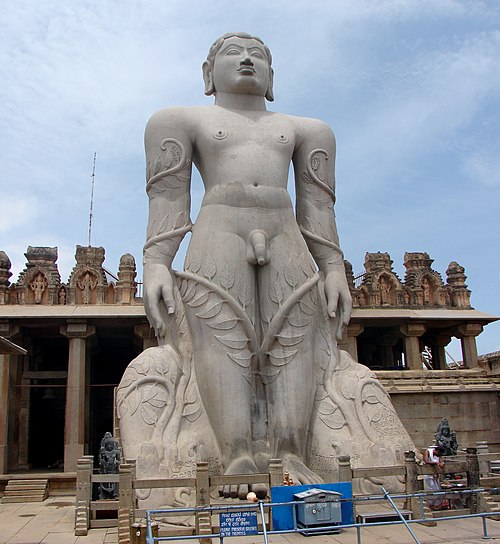
- vine creeper (climbing around statue's legs — no animal emblem as Bāhubali is not a Tīrthaṅkara)
- Sacred Colours
- saffronmilk-white
- Sacred Offerings
- tradition-specific (see text)
Primary Scriptures
1 source- Primary texts of Jain traditionscriptural / liturgical
Bāhubali of Śravaṇa Beḷagoḷa
Tradition: Jain / Digambara
This entry honours the self-representation of Jain tradition. India's sacred landscape includes hundreds of traditions beyond the Brahminical-Vedic canon — Jain, Buddhist, Sikh, Sufi Muslim, Zoroastrian, tribal Gondi/Bhil/Khasi, and many more. Each has its own cosmology, theology, ethical system, and sacred geography. Each deserves first-person recognition, not assimilation.
The Place — Shravanabelagola, Hassan
- Location: Shravanabelagola, Hassan, Karnataka (12.8572°N, 76.4883°E)
- Tradition: Jain / Digambara
- Historical: Statue carved 981 CE (Western Ganga dynasty, patron Chāmuṇḍarāya)
The Story
Bāhubali (Gommaṭa) — son of the first Tīrthaṅkara Ṛṣabhadeva — renounced his kingdom after a confrontation with his brother Bharata and stood in kāyotsarga (body-renunciation) meditation for one year, so motionless that vines grew around his legs. The 57-foot (18.2 m) monolithic statue at Śravaṇa Beḷagoḷa (Karnataka), carved 981 CE by Chāmuṇḍarāya, is the largest free-standing monolith in the world. The statue stands atop Vindhyagiri Hill. Every 12 years the Mahāmastakābhiṣeka is performed — the statue is anointed from scaffolding with milk, saffron, coconut water, vermilion, and sandalwood paste by thousands of ascetics and lay devotees. Last held in 2018; next 2030.
Worship Tradition
Worship in the Jain tradition follows its own ritual grammar — this is not a variant of Brahminical-Hindu worship. Key elements:
- Primary offering: see description
- Sacred colours: saffron, milk-white
- Mantra/Invocation: Namo Siddhānam
Festival Calendar
- Mahāmastakābhiṣeka (Phālguna (February–March) of designated year, 10 days every 12 years)
Why This Entry Matters
India is home to:
- 4.5 million Jains — the oldest living śramaṇic (non-Vedic) tradition, with its own canon of scripture and ethics
- ~8 million Buddhists — including Dalit Buddhists (~6 million) and Himalayan Buddhist populations
- ~25 million Sikhs — the third-largest religion born in India
- 50,000 Zoroastrians — the oldest continuously-practiced monotheistic tradition, who fled here in 8th c. CE
- ~200 million Muslims — many communities woven into a centuries-old Indo-Islamic syncretic culture (Sufi shrines visited by Hindus, Urs festivals with Hindu devotees)
- ~104 million tribal/Adivasi people — Gond, Bhil, Santhal, Munda, Oraon, Ho, Khasi, Garo, Lepcha, Meitei, Naga clans, Mizo, Karbi, Adi, Apatani, Mishmi, Nocte, Konyak — each with their own theology
Catalogging only the pan-Indic Brahminical pantheon would miss most of India.
Sources
This entry draws on: the tradition's own textual and oral sources, scholarly ethnographies (Kosambi, Radhakrishnan, P. V. Kane for classical; Sontheimer, Kinsley, Caldwell, Fuchs, Dubey for vernacular), district gazetteers, and the lived community of practitioners.
Wisdom Graph: Divine Associations
- Vāhana
- vine creeper (climbing around statue's legs — no animal emblem as Bāhubali is not a Tīrthaṅkara)
- Offerings
- tradition-specific (see text)
- Sacred colours
- saffronmilk-white
🪔 Worship Procedures
- Daily rites
- • tradition-specific (see body)
- Puja sequence
- tradition-specific
- Vratas (vows / fasts)
- • tradition-specific observances
🛕 Principal Temples
- Main shrine of Bāhubali of Śravaṇa BeḷagoḷaStatue carved 981 CE (Western Ganga dynasty, patron Chāmuṇḍarāya)
Sources & provenance
- 🎓Scholarly sourceBookJain traditions: scholarly and community sources
- 🎓Scholarly sourceBookP. V. Kane / D. D. Kosambi / S. Radhakrishnan.