Sacred Facts · At a Glance
- Element
- water
Primary Scriptures
0 sourcesNo primary scriptures are catalogued for this entry yet. If you know of scriptural references we have missed, please contribute them.
⚠️ CONTENT VERIFICATION STATUS: This draft is . All citations require validation.
Digambara Jainism
Section 1: Overview
[BEGINNER]
Digambara ("sky-clad") is one of the two great branches of Jainism, a religion of non-violence (ahiṃsā) that arose in ancient India. Digambara monks, following what they believe is the original practice of the last Tirthankara, Mahavira, renounce all possessions — including clothing — as a symbol of total detachment from the world.
Jainism teaches that the universe is eternal and that liberation (mokṣa) comes through purifying the soul of the karma that clings to it. The path is one of strict non-violence, truthfulness, non-stealing, celibacy, and non-attachment.
Key features of the Digambara tradition:
- Monks go naked — the most visible and contested of its practices
- No women can attain liberation in their present body — the most debated of its doctrines
- Its monks carry a peacock-feather whisk and an earthen water pot, symbolizing carefulness toward all life
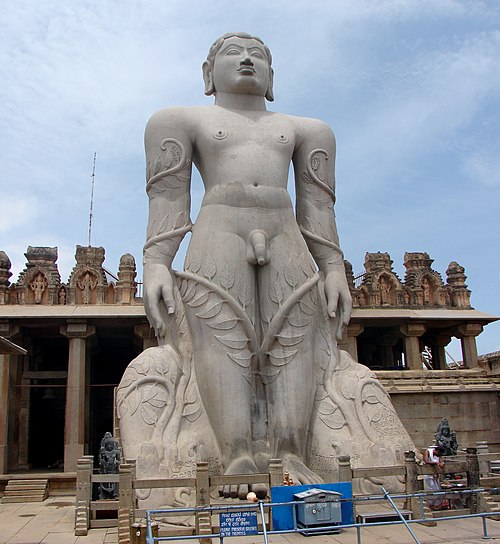
- Its great pilgrimage images, such as the Bahubali statue at Shravanabelagola in Karnataka, are among the largest free-standing sculptures in the world
[INTERMEDIATE]
The Digambara–Śvetāmbara division is Jainism's oldest and deepest schism, traditionally dated to a famine in Magadha (c. 300 BCE) and a later council at Vallabhi (5th century CE). The traditions differ on several fundamentals:
The schism:
- The Digambaras hold that the original Āgama scriptures were lost, and that no authentic canon survives from Mahavira's time. They rely instead on later works by great teachers such as Kundakunda and Umāsvāti's Tattvārtha Sūtra.
- The Śvetāmbaras hold that a canon (the Śvetāmbara Āgamas) was preserved, and that the 19th Tirthankara, Mallinātha, was a woman.
Distinctive doctrines:
- Nudity of monks — total renunciation requires abandoning clothing
- Female liberation — because women cannot go naked, they cannot attain mokṣa in a female body; they must be reborn as men first. (This doctrine is rejected by the Śvetāmbaras, who hold that women can attain liberation.)
- Mahavira's nudity — the Digambaras assert that Mahavira himself lived naked; the Śvetāmbaras hold he wore clothes after his enlightenment.
Important teachers and texts:
- Kundakunda (2nd–3rd century CE) — author of the Samayasāra and other classics of Digambara philosophy
- Umāsvāti (c. 2nd–5th century CE) — his Tattvārtha Sūtra, the "how-things-are" manual, is accepted by both branches
- Pūjyapāda, Akalaṅka, and Vidyānanda — great Digambara logicians and commentators
Section 2: Pilgrimage & Worship
[BEGINNER]
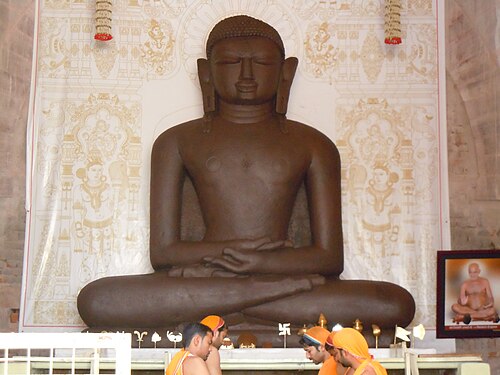
Digambara worship focuses not on gods who grant favours, but on the Tirthankaras — the twenty-four perfected teachers who have shown the way to liberation. Devotion (bhakti) is directed toward their images and footprints, as a reminder of the ideal.
Major pilgrimage sites:
- Shravanabelagola (Karnataka) — the 57-foot statue of Bahubali (Gommateshwara), anointed every 12 years in the Mahamastakabhisheka festival
- Mount Abu — the Dilwara temples, famed for their intricate marble carving (shared with the Śvetāmbaras)
- Shikharji (Jharkhand) — the hill where, in tradition, twenty Tirthankaras attained liberation
- Kundalpur and Gwalior — among the great Digambara temple complexes of central India
Daily practice:
- Praticakṣaṇa — a vow of repentance for unintentional harm
- Pratikramaṇa — a period of reflection and confession
- Fasting (upavāsa), especially during the festival of Paryushan
Section 3: Digambaras Today
[BEGINNER]
The Digambara community today is smaller than the Śvetāmbara, concentrated mainly in Karnataka, Maharashtra, and Madhya Pradesh. Despite its small numbers, its influence is large: the community supports schools, hospitals, and the teaching of non-violence, and its monks and scholars remain the custodians of a rigorous ascetic ideal.
Contemporary concerns:
- The nudity of monks continues in a small number of mendicants; most modern Digambara monks and nuns wear robes, a point of internal discussion
- Women's status within the tradition is debated both inside the community and by scholars, given the doctrine that women cannot attain liberation in a female birth
- The community is active in animal welfare, vegetarianism, and environmental care, natural extensions of ahiṃsā
In India, Digambara Jainism's living monastic tradition, its great pilgrimage sculptures, and its schools of logic and ethics represent a continuous thread from the ancient world to the present — a reminder of the deep diversity within India's religious heritage.
Known Limitations
- The dates and circumstances of the original schism are uncertain; both traditions offer their own accounts.
- The doctrine on female liberation is genuinely contested within and beyond the tradition; handled here with care.
- The question of whether Mahavira was naked is asserted by Digambaras and denied by Śvetāmbaras; this entry reports the positions without resolving them.
- Regional practice and internal sub-traditions are simplified.
- Academic study of the Digambara community is thinner than that of the Śvetāmbara.
Recommended reviewers: A Jain scholar (Prakrit/Sanskrit), a Digambara monk or community representative, a historian of Indian asceticism.
Standard Disclaimer
Sources & provenance
- 🎓Scholarly sourceBookPaul Dundas. The Jains (1992)
- 🎓Scholarly sourceBook