⚠️ CONTENT VERIFICATION STATUS: This draft is . All citations require validation.
Svetambara Jainism
Section 1: Overview
[BEGINNER]
Svetambara ("white-clad") is the larger of the two great branches of Jainism. Its monks and nuns wear simple white robes — in contrast to the Digambara ("sky-clad") monks who go naked — and its tradition holds that the ancient Āgama scriptures were preserved, so that it possesses the canon the Digambaras say was lost.
Jainism centres on ahiṃsā (non-violence), the most demanding ethical code of the Indian traditions: every effort is made to avoid harming any living being, including insects and microorganisms. Liberation (mokṣa) is attained by erasing karma through right faith, right knowledge, and right conduct.
Key features of the Svetambara tradition:
- White robes for monks and nuns — the practical expression of its less radical renunciation
- Women can attain liberation — in this tradition, a woman may become a Tirthankara and reach mokṣa; the 19th Tirthankara, Mallinātha, is held to have been female
- It preserves the Āgama canon, recited orally for centuries and written down at the Council of Vallabhi (5th century CE)
- Its monks wear the muhapatti, a cloth over the mouth to avoid harming airborne life
[INTERMEDIATE]
The Svetambara tradition traces its identity to the period after Mahavira's nirvāṇa (traditionally 527 BCE). Its account of the schism differs from the Digambara account:
The tradition's self-understanding:
- The Āgamas — the teachings of the Tirthankaras — were transmitted orally through a lineage of śruta-kevalins ("those who know the whole canon") and preserved until the Council of Vallabhi, when they were committed to writing.
- The canon comprises 45 texts in Ardhamagadhi Prakrit, arranged in 12 Aṅgas (limbs), 12 Upāṅgas, 10 Prakīrṇakas, 6 Chhedasūtras, 4 Mūlasūtras, and 2 Cūlikāsūtras.
- Key texts include the Ācārāṅga Sūtra (the earliest, on conduct), the Sūtrakṛtāṅga, the Uttarādhyayana, and the Kalpa Sūtra, which contains the traditional biographies of the Tirthankaras.
Distinctive doctrines:
- Clothing — the Svetāmbaras hold that Mahavira wore clothes after enlightenment, and that total renunciation does not require nudity
- Female liberation — women can attain mokṣa; Mallinātha's example is central
- A scripture preserved — the tradition maintains that an authentic canon survives, against the Digambara claim of total loss
Important teachers:
- Umāsvāti — whose Tattvārtha Sūtra is accepted by both branches
- Haribhadra (8th century) — a great philosopher and storyteller
- Hemacandra (12th century) — scholar, grammarian, and court poet of the Gujarat kingdom
- Ācārya Hiravijayasūri — who famously met the Mughal emperor Akbar in 1584, leading Akbar to curtail animal slaughter during the Jain festival period
Section 2: Pilgrimage & Worship
[BEGINNER]
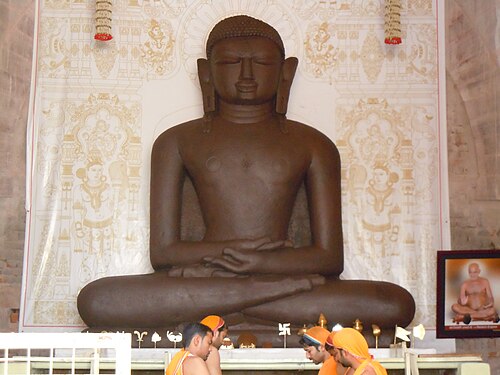
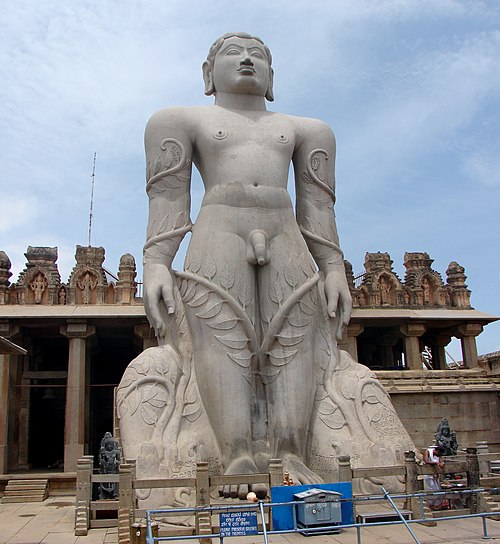
Like all Jains, Svetāmbaras worship the Tirthankaras through their images, but with a notable difference: Svetambara images are given eyes, while Digambara images are not — a visible sign of the two traditions' differing views of Mahavira's life.
Major pilgrimage sites:
- Palitana (Gujarat) — the hilltop temple city of the Śatruñjaya hills, the most sacred Svetambara site, with over 800 temples
- Mount Abu (Rajasthan) — the Dilwara temples, masterpieces of white marble carving
- Ranakpur (Rajasthan) — a vast 15th-century marble temple complex
- Pawapuri (Bihar) — where Mahavira is said to have attained nirvāṇa
Daily practice:
- Pratikramaṇa — confession and repentance, performed daily and at festivals
- Paryushan — the eight-day festival of reflection and fasting
- The five great vows — non-violence, truth, non-stealing, celibacy, non-attachment
Section 3: Svetambaras Today
[BEGINNER]
The Svetambara community is today the largest Jain community, concentrated especially in Gujarat, Rajasthan, and Mumbai, with significant diaspora communities in East Africa, the United Kingdom, and North America. The great merchant communities of western India have long been overwhelmingly Jain, and the tradition's values of non-violence, frugality, and charity remain strong.
Contemporary life:
- Murtipujak (image-worshipping), Sthānakavāsī (image-less), and Terāpanthī (an iconoclastic reform order founded in the 18th century) are the main internal divisions, with significant differences in ritual
- Jains are leaders in vegetarianism, animal welfare, and environmental ethics, and many serve as trustees of India's great hospitals and universities
- The diaspora has built Jain centres worldwide, preserving the Āgama teachings and the festival cycle
In India and the world, Svetambara Jainism carries forward one of the oldest continuous traditions of non-violence — a living school of ethics whose influence extends far beyond the community itself.
Known Limitations
- The date of the Vallabhi council and the exact contents of the early canon are debated.
- The claim that Mallinātha was female is contested by the Digambaras; this entry reports the Svetambara position.
- The three internal divisions (Murtipujak, Sthānakavāsī, Terāpanthī) differ considerably in practice; simplified here.
- The relationship of the Svetambara and Digambara accounts of the schism cannot be resolved from historical evidence alone.
- Regional and diaspora variations are underrepresented.
Recommended reviewers: A Jain scholar (Prakrit specialist), a Svetambara monk or community representative, a historian of western Indian religion.
Standard Disclaimer