

.jpg/500px-Indra%2C_Chief_of_the_Gods_LACMA_M.69.13.4_(1_of_5).jpg)


Sacred Facts · At a Glance
- Gender
- male
- Sacred Number(s)
- 24 · 27
- Sacred Colours
- white (Digambara) / crimson (Svetāmbara iconography)
- Sacred Flowers
- white flowers
- Sacred Trees
- aśoka tree (under which kevala-jñāna attained) · shāla tree (Shorea robusta)
- Sacred Offerings
- rice · sandalwood paste · saffron · incense · lamps · pure water · fruit · sweets (aṣṭa-prakārī pūjā)
- Sacred Animals
- lion (siṃha lāñchana — Jain emblem, not a mount; Tīrthaṅkaras do not ride animals)
Primary Scriptures
4 sources- Ācārāṅga SūtraagamaComposed c. 5th c. BCE – 4th c. CE
- Kalpa SūtraagamaBhadrabāhuComposed c. 4th c. BCE
- Tattvārtha SūtrashastraUmāsvātiComposed c. 2nd c. CEFoundational text recognized by all Jain sects
Mahavira: The Great Hero of Jainism
[BEGINNER]
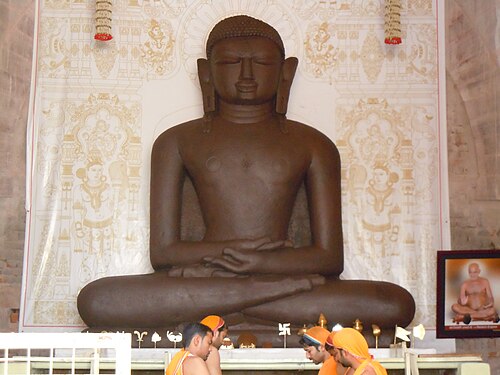
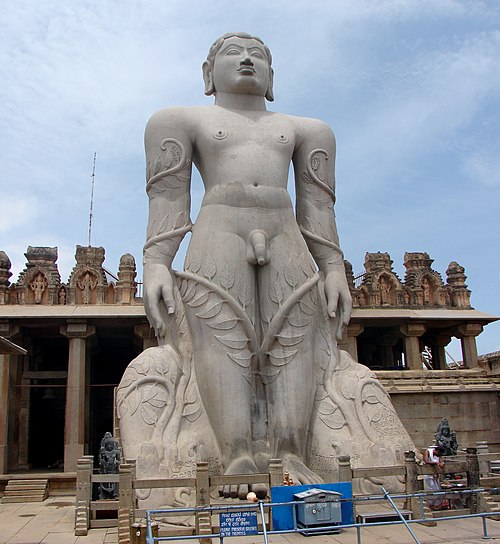
Mahavira (meaning "Great Hero") is the 24th and most recent Tirthankara (ford-maker/spiritual teacher) of Jainism, born as Vardhamana around 599 BCE in Bihar, India. He is considered the founder of the Jain religion as it exists today, though he is understood within Jain tradition as one in a long line of 24 Tirthankaras stretching back through countless previous world cycles. Mahavira renounced worldly life at age 30 after his father's death, and spent 12 years as an ascetic practicing extreme non-violence (ahimsa), meditation, and fasting until he achieved Kevya (omniscience). He then taught for 30 years until his death at age 72 in Pawapuri. The core teachings he established — ahimsa (non-violence), anekantavada (multi-faceted truth), and aparigraha (non-attachment) — form the foundation of Jain philosophy. He is depicted in Jain temples as a sitting or standing figure with the lion (Simha) as his emblem (lāñchana), though unlike Hindu gods, the Tirthankaras are understood as enlightened beings who have shown the path, not as creators or saviors. The siṃha lāñchana signifies Mahāvīra's spiritual sovereignty, not a vehicle.
[INTERMEDIATE]
The Jain tradition distinguishes between the "conventionally historical" Mahavira and the "literally real" Mahavira who existed in all previous world cycles as the 24th Tirthankara. The Acaranga Sutra describes his 12 years of severe asceticism including standing motionless for long periods, exposing himself to harsh weather, and practicing strict fasting. His teaching that "all soul is intrinsically divine but bound by karmic matter" establishes the Jain understanding that liberation comes through removing karmic impurities rather than through external divine intervention. The Navakar Mantra (the most important Jain prayer) addresses all 24 Tirthankaras, acknowledging Mahavira as the last of the current cycle. The split between Digambara (sky-clad/skyclad) and Svetambara (white-clad) Jains occurred after Mahavira's death, with differences in ascetic practice and textual canon reflecting different interpretations of his original teachings.
[SCHOLAR]
Academic study of Mahavira reveals one of the most complex questions in Indian religious history — the relationship between Mahavira and the Buddha, who lived in the same region during roughly the same period. The Jain tradition claims Mahavira was older than Buddha and that Buddhist texts borrowed from Jain concepts, while Buddhist traditions make the reverse claim. The historical evidence, including archaeological and textual studies, remains inconclusive. The Acaranga Sutra's detailed description of Mahavira's ascetic practices represents one of the most important primary sources for understanding early Jainism, though scholars debate its dating. The Jain concept of Tirthankara as "ford-maker" — one who creates a crossing over the ocean of rebirth — represents a sophisticated metaphor for spiritual liberation unique to the Jain tradition. The development of Mahavira's image as an object of worship (while maintaining the doctrine that Tirthankaras have achieved liberation and cannot intervene in worldly affairs) represents one of the interesting tensions in Jain religious practice.
[/SCHOLAR]
Core Teachings
1. Non-Violence Is the Highest Duty — Mahavira's teaching that ahimsa (non-violence in thought, word, and deed) is the highest religious duty establishes the foundation of Jain ethics and its radical commitment to non-harm.
2. Truth Has Many Sides — Anekantavada (multi-faceted truth) teaches that no single perspective can capture the full truth, that understanding requires considering multiple viewpoints with equanimity.
3. Non-Attachment Leads to Liberation — Aparigraha (non-attachment to possessions, relationships, and ideas) removes the karmic bonds that keep souls trapped in the cycle of rebirth.
Daily Practice
[BEGINNER]
- Chant the Navakar Mantra daily, which includes salutation to Mahavira as the 24th Tirthankara
- Practice ahimsa in daily life by becoming aware of violence in thoughts, words, and actions
- Study Mahavira's life story to understand the Jain model of spiritual progress
- Visit Jain temples and observe the reverence shown to Mahavira's image
[INTERMEDIATE]
- Study the Acaranga Sutra's detailed account of Mahavira's ascetic practices
- Practice the Jain meditation techniques (Dhyana) on the form of Mahavira
- Observe the Jain festivals (Mahavira Jayanti in March/April) with proper understanding
- Practice the Svadhyaya (self-study) recommended in Jain texts
[SCHOLAR]
- Master the Sanskrit and Prakrit Jain texts describing Mahavira's life and teachings
- Study the philosophical system of Anekantavada and its relationship to Mahavira's teachings
- Research the comparative studies between Mahavira and Buddha with scholarly objectivity
- Engage with the academic debates about Jain origins and Mahavira's historical dating
- Learn the differences between Digambara and Svetambara interpretations of Mahavira's teachings
[/SCHOLAR]
Sacred Texts
| Text | Description | Key References |
|---|---|---|
| Acaranga Sutra | Mahavira's life and practices | Primary Jain text |
| Kalpa Sutra | Life of Mahavira and other Tirthankaras | Svetambara canon |
| Mahavira Charitra | Traditional biography | Later text |
| Uttaradhyayana Sutra | Jain teachings | Early text |
Living Tradition
Mahavira's birthday (Mahavira Jayanti) is celebrated as one of the most important Jain festivals, with temple celebrations, processions, and fasting across Jain communities worldwide. The Digambara and Svetambara branches maintain slightly different practices regarding Mahavira worship, though both revere him as the 24th Tirthankara. The Navakar Mantra is chanted daily by devout Jains as the first thing in the morning. The city of Pawapuri (where Mahavira attained moksha) remains a major pilgrimage site. The Rajagriha area in Bihar where Mahavira was born continues to be maintained as a sacred site by Jain communities. The spread of Jainism through the Indian diaspora has carried Mahavira's teachings to communities across the globe.
Known Limitations
This profile focuses on Jain Mahavira and should not be conflated with Buddhist or Hindu figures (though the historical interactions between traditions are academically significant). The academic study of Mahavira's historical dating and its relationship to Buddha remains contested among scholars. The difference between Digambara and Svetambara Jain perspectives on Mahavira represents important internal diversity that should be understood. The practice of worshipping Tirthankara images (while doctrinally understood as reverence for the path rather than petition to a god) represents a complex practice requiring understanding within Jain theological frameworks.
Wisdom Graph: Divine Associations
- Sacred animals
- lion (siṃha lāñchana — Jain emblem, not a mount; Tīrthaṅkaras do not ride animals)
- Sacred flowers
- white flowers
- Sacred trees
- aśoka tree (under which kevala-jñāna attained)shāla tree (Shorea robusta)
- Offerings
- ricesandalwood pastesaffronincenselampspure waterfruitsweets (aṣṭa-prakārī pūjā)
- Sacred colours
- white (Digambara) / crimson (Svetāmbara iconography)
- Sacred numbers
- 2427
📜 Primary Scriptural Sources
- Ācārāṅga Sūtraagamac. 5th c. BCE – 4th c. CE
- Kalpa Sūtraagamac. 4th c. BCEBhadrabāhu
Sources & provenance
- 📖Supporting referenceOtherJain Sutras
- 📖Supporting referenceOtherAcaranga Sutra
- 📖