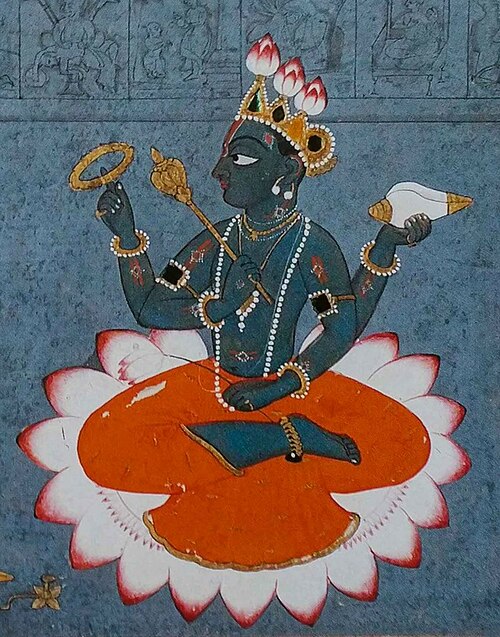
Yajurveda (यजुर्वेद — The Veda of Sacrificial Formulas)
"Namaste astu bhagavan viśveśvarāya mahādevāya tryambakāya tripurāntakāya..."
— Kṛṣṇa Yajurveda, Taittirīya Saṁhitā 4.5 (Śrī Rudram)
Overview
The Yajurveda is the second of the four canonical Vedas (Śruti) and the foundational liturgical manual of the Adhvaryu priest, who executes the physical geometry, altar construction (agnicayana), and oblations of the Vedic sacrifice (yajña). While the Ṛgveda compiles metrical hymns (ṛc) for invocation and the Sāmaveda sets verses to musical chant (sāman), the Yajurveda preserves terse prose formulas and mantras (yajus, from the root yaj, "to worship/sacrifice") spoken directly over the sacred fire.
Uniquely among the four Vedas, the Yajurveda is transmitted in two great textual branches:
- Kṛṣṇa Yajurveda ("Black" or "Unarranged" Yajurveda): Integrates the sacrificial mantras (Saṁhitā) and their theological-ritual explanations (Brāhmaṇa prose) within a single continuous corpus.
- Śukla Yajurveda ("White" or "Luminous/Separated" Yajurveda): Revealed to Sage Yājñavalkya by the Sun-god Āditya (Sūrya) in the form of a horse (Vājin), separating the pure mantras into the Vājasaneyi Saṁhitā and placing all explanatory prose into the monumental Śatapatha Brāhmaṇa.
The Two Recensions & Their Surviving Śākhās
| Tradition |
Surviving Śākhās (Schools) |
Associated Brāhmaṇa & Āraṇyaka |
Principal Upaniṣads |
| Kṛṣṇa Yajurveda |
1. Taittirīya (widely recited across South India)
2. Maitrāyaṇī (Maharashtra/Gujarat)
3. Kāṭhaka (Caraka-Kaṭha, Kashmir)
4. Kapiṣṭhala-Kaṭha (fragmentary, Punjab) |
Taittirīya Brāhmaṇa & Taittirīya Āraṇyaka |
Taittirīya Upaniṣad, Kaṭha Upaniṣad, Śvetāśvatara Upaniṣad, Maitrāyaṇīya Upaniṣad, Mahānārāyaṇa Upaniṣad |
| Śukla Yajurveda |
1. Mādhyandina (predominant across North India, Nepal)
2. Kāṇva (Maharashtra, Odisha, Tamil Nadu, Karnataka) |
Śatapatha Brāhmaṇa (100 adhyāyas in Mādhyandina; 104 in Kāṇva) |
Īśāvāsya Upaniṣad (Vājasaneyi Saṁhitā Ch. 40) & Bṛhadāraṇyaka Upaniṣad (Śatapatha Brāhmaṇa Book 14) |
Core Liturgical & Philosophical Landmarks
1. The Śrī Rudram (Śatarudrīya) & Camakam
At the exact midpoint of the Kṛṣṇa Yajurveda (Taittirīya Saṁhitā 4.5 and 4.7, parallel to Vājasaneyi Saṁhitā Ch. 16) stands the Śrī Rudram (Namakam and Camakam). In the Namakam, Rudra-Śiva is saluted across every stratum of reality — in the storm, the forest trees, the mountain peaks, the potter, the artisan, the outcast, and the innermost heart — and at the exact center of the hymn (TS 4.5.8.1) appears the Pañcākṣarī Mantra (Namaḥ Śivāya).
2. The Agni-cayana (Piling of the Falcon Fire Altar)
Kāṇḍas 4 and 5 of the Taittirīya Saṁhitā and Books 6–10 of the Śatapatha Brāhmaṇa codify the Agnicayana: the construction of a five-layered brick altar in the shape of a soaring falcon (śyena) using precisely numbered bricks accompanied by cosmic mantras, identifying the sacrificial altar with Prajāpati, the course of the solar year, and the human body.
3. The Īśā and Bṛhadāraṇyaka Upaniṣads
Chapter 40 of the Śukla Yajurveda Saṁhitā is the Īśāvāsya Upaniṣad — the only principal Upaniṣad embedded directly inside a Vedic Mantra-Saṁhitā rather than an Āraṇyaka or Brāhmaṇa, opening with the declaration: "Īśāvāsyam idaṁ sarvaṁ yat kiñca jagatyāṁ jagat" ("All this — whatever moves in this moving world — is pervaded by the Lord").