


_cropped.png/500px-Krishna_Holds_Up_Mount_Govardhan_(MET_70694)_cropped.png)


Sacred Facts · At a Glance
- Gender
- male
Primary Scriptures
0 sourcesNo primary scriptures are catalogued for this entry yet. If you know of scriptural references we have missed, please contribute them.
Vitthala of Pandharpur
The Warkari God
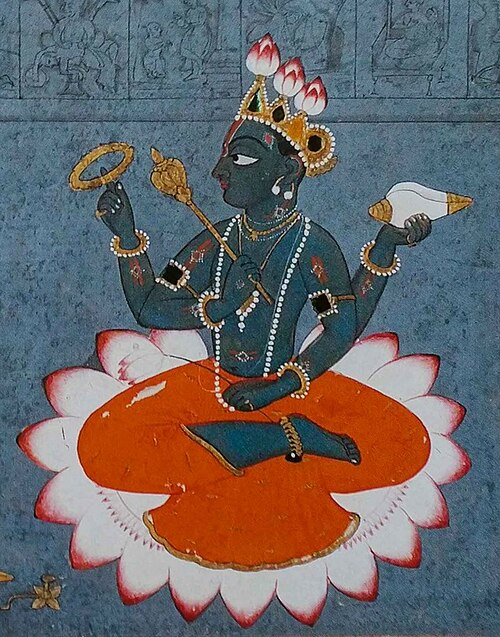
Vitthala (Marathi: विठ्ठल; also Vithoba, Pandurang, Pandharinath) is the Vishnu-form presiding at Pandharpur, Maharashtra — the theological centre of the Warkari sampradaya, the bhakti movement that from the 13th to 17th centuries produced an extraordinary poetic canon (Jnaneshvar, Namdev, Eknath, Tukaram) and shaped modern Marathi religious and literary identity. He is the Maharashtra T0 anchor; the annual Pandharpur Wari pilgrimage is among the oldest continuously-observed foot-pilgrimages in India.
The distinctive image
Vitthala's mula-vigraha is unlike any other major Vishnu image:
- Arms akimbo, hands resting on his hips — not in the standard Vaishnava mudra configuration;
- Standing on a brick (the mythological brick thrown by the devotee Pundalik, on which Vishnu balanced while waiting for Pundalik to finish tending to his parents);
- Crowned but otherwise relatively unadorned;
- Companion image of Rukmini (not Lakshmi) in an adjacent sanctum — a deliberate Krishnaite identification.
The akimbo pose and the brick are the iconographic signature of the deity and of the Pundalik legend, which Deleury (1960) identifies as the narrative scaffolding for the Warkari theological claim that the deity waits for his devotees, rather than requiring their approach.
The Warkari poetic canon
Pandharpur's theological centrality is inseparable from the poets it produced. The Warkari sampradaya is effectively defined by its abhanga tradition — the metrical Marathi devotional songs addressed to Vitthala:
- Jnaneshvar (1275–1296) — the Jnaneshvari, a Marathi commentary on the Bhagavad Gita that is a founding text of Marathi literature;
- Namdev (1270–1350) — whose abhangas are also incorporated into the Sikh Guru Granth Sahib (61 hymns);
- Eknath (1533–1599) — the Eknathi Bhagavata commentary;
- Tukaram (1608–1650) — the canonical abhanga voice, widely read as India's equivalent to European devotional poets like Hadewijch or San Juan de la Cruz. Chitre's (1991) Says Tuka is the definitive English translation.
The tradition also notably includes lower-caste and Dalit saints — Chokhamela and his family — whose inclusion is structurally important to Warkari self-understanding as a caste-transcendent tradition, even as scholars (including Zelliot 1976) have documented how this ideology has been inconsistent in practice.
The Wari pilgrimage
Each year, in the lunar month of Jyeshtha/Ashadha (June–July), the palkhis (palanquins) of Jnaneshvar from Alandi and Tukaram from Dehu are carried on foot to Pandharpur for Ashadhi Ekadashi — a 21-day walk of ~250 km, joined by hundreds of thousands of warkaris. The palkhis travel in a complex choreography of dindis (pilgrim groups), ringan (ritual runs), and overnight muquam halts; the scholarly ethnography by Deleury (1960) remains the authoritative description, though more recent work by Sulochana Gawde and the Maharashtra State Gazetteer series has updated the numbers (~1.5 million arriving at Pandharpur on Ekadashi).
Why this entry matters
Vitthala is the Maharashtra T0 anchor, the theological node of the Warkari tradition, and the anchor for any future entries on Marathi bhakti poetry. The continuous textual and ethnographic record from the 13th century makes this one of the best-documented deities in Indian religion.
Wisdom Graph: Divine Associations
- Vāhana
- Garuḍa
Sources & provenance
- 📜Primary sourceBookG. A. Deleury. The Cult of Viṭhobā (1960) pp. 1–221Deccan College Postgraduate and Research Institute; foundational scholarly monograph
- 📜Primary sourceBook