


.jpg/500px-Ajanta_(63).jpg)



Sacred Facts · At a Glance
- Vahana
- lion-throne (siṃhāsana — seat of authority, not a mount)
- Element
- air
- Sacred Colours
- saffronwhitegold
- Sacred Flowers
- lotus (padma — symbol of awakening)
- Sacred Trees
- Bodhi tree (planted at Sarnath from a sapling of the Bodh Gaya tree)
- Sacred Offerings
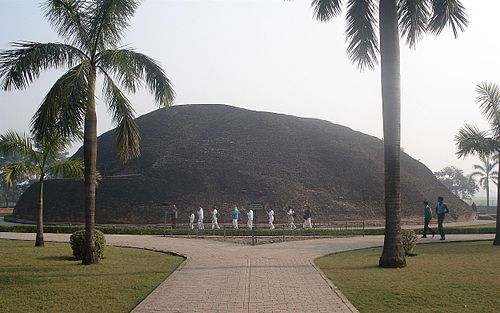
- incense · lotus flowers · butter lamps · circumambulation (pradakṣiṇa) of the Dhamek Stupa
- Sacred Animals
- deer (mṛga — the Deer Park, Migadāya, where the Buddha taught) · lion — Ashokan lion capital (now India's national emblem); not a vahana, a symbol of sovereignty
Primary Scriptures
2 sources- Dhammacakkappavattana Sutta (Setting the Wheel of Dhamma in Motion)suttaThe Buddha's first sermon — the Four Noble Truths and the Eightfold Path
- Anattalakkhaṇa Sutta (The Discourse on Non-Self)suttaThe Buddha's second sermon at Sarnath, after which all five listeners became arahants
Sarnath — Where the Wheel of Dhamma Began to Turn
The Deer Park — Migadāya
Sarnath — ancient Isipatana — is the site of the Buddha's first sermon, delivered in the Deer Park to five ascetics who had been his companions during his years of extreme austerities. The sermon, known as the Dhammacakkappavattana Sutta ("Setting the Wheel of Dhamma in Motion"), established the Four Noble Truths and the Eightfold Path — the core framework of all Buddhist teaching.
The Buddha chose Sarnath deliberately: it was on a major trade route, near the great city of Varanasi, in a deer park where animals were protected. The setting embodied his teaching — the Middle Way between the palace (luxury) and the forest (extreme asceticism).
The Ashokan Lion Capital
In the 3rd century BCE, Ashoka erected a polished sandstone pillar at Sarnath. Its capital — four lions standing back-to-back, surmounting a drum with four animals (elephant, bull, horse, galloping deer) separated by four Dhamma wheels — is the most important piece of Indian sculpture ever found.
In 1950, the lion capital was adopted as India's national emblem; the Dhamma wheel beneath it became the wheel on India's flag. The Ashokan lions of Sarnath now appear on every Indian coin, every government building, every passport — the Buddhist emperor's symbol of righteous rule, repurposed for a secular republic.
The Dhamek Stupa
The Dhamek Stupa — a massive cylindrical brick-and-stone structure 43.6 m high and 28 m in diameter — marks the traditional spot of the first sermon. Its lower portion is Ashokan; the upper portion was enlarged in the 5th century CE under Kumara Gupta I. The stupa's delicately carved stone panels — geometric patterns, floral designs, birds, and human figures — belong to the Gupta period, the golden age of Indian art.
Aniconic Tradition
Like Sanchi, the earliest Buddhist art at Sarnath is aniconic — the Buddha is represented by symbols (the wheel, the deer, the empty throne, the Bodhi tree). By the Gupta period (4th–6th c. CE), Sarnath had become the greatest centre of Buddha-image production in India; the Sarnath school produced the finest Buddha images ever made — serene, meditative, with the distinctive transparent wet drapery and the Dhammacakra-mudrā (teaching gesture).
Wisdom Graph: Divine Associations
- Vāhana
- lion-throne (siṃhāsana — seat of authority, not a mount)
- Sacred animals
- deer (mṛga — the Deer Park, Migadāya, where the Buddha taught)lion — Ashokan lion capital (now India's national emblem); not a vahana, a symbol of sovereignty
- Sacred flowers
- lotus (padma — symbol of awakening)
- Sacred trees
- Bodhi tree (planted at Sarnath from a sapling of the Bodh Gaya tree)
- Offerings
- incenselotus flowersbutter lampscircumambulation (pradakṣiṇa) of the Dhamek Stupa
- Sacred colours
- saffronwhitegold
📜 Primary Scriptural Sources
- Dhammacakkappavattana Sutta (Setting the Wheel of Dhamma in Motion)suttaThe Buddha's first sermon — the Four Noble Truths and the Eightfold Path
- Anattalakkhaṇa Sutta (The Discourse on Non-Self)suttaThe Buddha's second sermon at Sarnath, after which all five listeners became arahants
Sources & provenance
- 📜Primary sourceBookJohn Marshall. The Monuments of Sārnāth (1936)
- 📜



