Sacred Facts · At a Glance
- Gender
- male
- Vahana
- Flies through the cosmic atmosphere by his own divine wind-power (Vāyu-vega); often depicted carrying Rama and Lakshmana on his shoulders
- Weapon
- Gadā (golden mace of supreme physical power) · Mountain of Sanjeevani herbs · Vajra-deha (adamantine physical body that repels all celestial weapons)
- Element
- air
- Sacred Number(s)
- 5 · 8 · 11 · 40 · 108
- Sacred Colours
- radiant vermilion orange (sindūr)deep crimson redbright saffron
- Sacred Flowers
- red hibiscus (japā-kusuma) · marigold (genda) · arka flowers (Calotropis) · aparājitā (blue pea)
- Sacred Trees
- peepal (aśvattha — where circumambulation pacifies Saturn's malefic effects) · banyan · śamī
- Sacred Offerings
- sindūra (vermilion paste applied all over the murti with jasmine oil / Chameli tel) · boondi laddus · gur-chana (jaggery and roasted gram) · tulsi mala · betel leaf garland (vetrilai malai in Tamil tradition)
- Sacred Animals
- vanara (monkey warriors) · cow (protected by Maruti)
- Sacred Plants
- tulasī (garlands of tulsi leaves offered to Hanuman) · arka plant · darbha grass
Primary Scriptures
6 sources- Sundarakāṇḍa (Vālmīki Rāmāyaṇa, Book 5)epicComposed c. 5th–4th c. BCE68 chapters solely dedicated to Hanuman's heroic reconnaissance mission to Lanka, his discovery of Mother Sita, and the demonstration of vanara valor
- Hanumān ChālīsābhaktiGoswāmī TulsīdāsComposed 1576 CE40 Awadhi chaupais composed in Varanasi celebrating Hanuman's divine virtues, widely acknowledged as the most frequently recited prayer in northern India
- RāmcaritmānasbhaktiGoswāmī TulsīdāsComposed 1574 CEThe Sundara and Lanka Kandas present Hanuman as the personification of selfless service and ocean of wisdom
- Saṅkaṭamocana HanumānāṣṭakastotraGoswāmī TulsīdāsComposed 16th c. CEEight stanzas recounting Hanuman's heroic deeds, recited to ward off acute misfortune and physical danger
- Parāśara SaṃhitāpuranaPancharatra canonical scripture detailing Hanuman's cosmic genealogy, his marriage to Suvarchala (solar manifestation), and the worship of Panchamukha Hanuman
- Hanumān BāhukastotraGoswāmī TulsīdāsComposed by Tulsidas when stricken by agonizing physical illness, petitioning Hanuman's healing grace
Hanuman
The Supreme Devotee — Ocean of Wisdom, Heroic Strength, and Eternal Chiranjeevi
Overview
Lord Hanuman (हनुमान्) — celebrated as Māruti, Pavanaputra, Bajarangabalī, Keśarīnandana, Saṅkaṭamocana, and Āñjaneya — is the supreme personification of Bhakti (devotion), Jñāna (wisdom), Vairāgya (dispassion), and Śakti (physical and spiritual strength) in Sanatana Dharma.
In the Rāmāyaṇa, Hanuman occupies an extraordinary theological role:
- He is the Dūta (ambassador) who bridges the separation between Sri Rama (the Supreme Self) and Devi Sita (the embodied soul).
- He is the Jīvanmukta (liberated master) who possesses all eight supernatural yogic powers (Aṣṭa-siddhis) and nine treasures (Nava-nidhis), yet chooses only to serve as the humblest servant of Rama.
- He is one of the eight sacred immortals (Cirañjīvins) destined to live until the end of the Kalpa, remaining present on earth wherever Sri Rama's name is chanted with sincere tears of devotion.
Century-by-Century Archaeological & Epigraphical Evolution
5th c. BCE        5th c. CE        760 CE           10th–12th c.    15th c. CE      1576 CE         17th c. CE
    │                │                │                 │               │               │               │
    ▼                ▼                ▼                 ▼               ▼               ▼               ▼
Valmiki          Gupta Stone      Ellora           Imperial        Vyasatirtha     Tulsidas        Samarth Ramdas
Sundara Kanda    Reliefs          Cave 16          Chola           Hampi           Hanuman         11 Maruti
Adi Kavya        Nachna & Deogarh Bas-Reliefs      Bronzes         Yantrodharaka   Chalisa         Fort Temples
1. Vedic Roots & The Valmiki Epic (c. 5th–4th c. BCE)
- In the Ṛgveda (10.86), the enigmatic dialogue of Vṛṣākapi (the divine ape) represents the Vedic precursor of the sacred monkey ally.
- In the Valmiki Ramayana (Kishkindha Kanda, Chapter 3), when Rama first hears Hanuman speaking on the banks of Pampa lake, Rama turns to Lakshmana in sheer astonishment at Hanuman's flawless linguistic and grammatical erudition:
नानृग्वेदविनीतस्य नाऋग्वेदविनीतस्य नायजुर्वेदधारिणः ।
नासामवेदविदुषः शक्यमेवं विभाषितुम् ॥
नूनं व्याकरणं कृत्स्नमनेन बहुधा श्रुतम् ।
बहु व्याहरतानेन न किञ्चिदपशब्दितम् ॥
"No one who is unversed in the Rigveda, none who hasn't mastered the Yajurveda, none ignorant of the Samaveda could speak with such sublime eloquence! Truly, he has thoroughly mastered the entire science of grammar; though he has spoken at great length, not a single flawed word has escaped his lips!"
2. Imperial Gupta Stone Reliefs (c. 5th c. CE)
- In the sandstone narrative carvings of the Deogarh Dashavatara Temple and Nachna Kuthara, Hanuman is sculpted leading the vanara army, carrying boulders, and receiving the signet ring (anguliyaka) from Rama. His posture balances animal energy with divine awareness.
3. Rashtrakuta Rock-Cut Splendor: Ellora Cave 16 (c. 760 CE)
- In the Kailasanatha temple rock-cut plinth, a series of dynamic high-relief panels recount:
- Hanuman's heroic leap across the ocean (Sāgara-taraṇa).
- His confrontation with the demon king Ravana in his golden palace.
- The famous episode where the rakshasas set fire to his tail, and Hanuman leaps across the ramparts of Lanka, transforming their golden city into a sea of cleansing flames (Laṅkā-dahana).
4. Imperial Chola Lost-Wax Bronzes (c. 10th–12th c. CE)
- Chola master craftsmen cast the definitive South Indian iconographic model:
- Hanuman stands humbly in samabhaṅga posture with his knees slightly flexed.
- His hands are folded in Añjali Mudrā (prayer) or his right hand covers his mouth in modest deference before royalty.
- His long tail curves gracefully over his head in a heroic arch (Vīra-vāla) or rests coiled at his feet.
- He wears the sacred thread (yajñopavīta), the calf anklet (vīra-kaḻal), and a crown of jewels.
5. Vijayanagara Empire & Sri Vyasatirtha (15th–16th c. CE)
- The Yantrodharaka Anjaneya (Hampi): Sri Vyasatirtha, the celebrated Dvaita master and royal preceptor to King Krishnadevaraya, sat in deep meditation on Anjeyanadri Hill. An icon of Hanuman appeared to him, which he carved upon a rock enclosed within a hexagonal Yantra. Around the perimeter of the yantra, twelve monkeys hold each other's tails, representing the twelve months of continuous protection.
- Vyasatirtha took a sacred vow to consecrate 732 Hanuman shrines across the Vijayanagara Empire to reinforce the spiritual and physical resilience of the populace.
- Monumental freestanding granite colossi were erected across the southern realm:
- Namakkal Anjaneyar (18 feet, open to the sky).
- Suchindram Anjaneyar (22 feet, carved from a single granite boulder).
6. Goswami Tulsidas & Awadhi Bhakti (1574–1576 CE)
- In Varanasi, Goswami Tulsidas founded the Sankat Mochan temple on the Assi river and composed the Hanumān Chālīsā (40 verses in Awadhi). The hymn became the most widely memorized and recited prayer across northern India:
संकट ते हनुमान छुड़ावै । मन क्रम बचन ध्यान जो लावै ॥
"Hanuman delivers from all distress those who meditate upon him in thought, action, and speech."
7. Maratha Fort Grid & Samarth Ramdas (17th c. CE)
- Samarth Ramdas Swami, spiritual guide of Chhatrapati Shivaji Maharaj, recognized Hanuman as the ideal archetype for uniting physical valor (bala) with spiritual righteousness (dharma). He established the 11 Maruti temples across Maharashtra and consecrated a Maruti shrine at the entrance of every Maratha hill fort (Pratapgad, Raigad, Sinhagad).
Iconographic Anatomy & Esoteric Symbolism
                  [ ARCHED TAIL (Vīra-Vāla) ]
          Heroic Valor, Gateway of Cosmic Fire
                           ▲
                           │
  [ GADĀ (Golden Mace) ] ──┼── [ SANJEEVANI MOUNTAIN ]
   Destruction of ego,     │    Restorer of life,
   unshakable resolve      │    compassionate rescue
                           ▼
              [ SINDŪR (Vermilion Hue) ]
          Radiance of life force, total surrender
                           │
                           ▼
             [ AÑJALI MUDRĀ (Folded Palms) ]
         Complete ego-loss in the presence of Rama
- The Vermilion Robe (Sindūra): Tradition relates that upon seeing Mother Sita apply vermilion (sindūr) to the parting of her hair to ensure Rama's longevity, Hanuman joyfully smeared his entire body with vermilion, reasoning that if a pinch brought long life, covering his whole body would make his Lord immortal. Sindūr represents total, guileless self-surrender.
- The Golden Mace (Gadā): Symbolizes the power to smash the arrogant ego (ahaṃkāra) and destroy negative psychic influences.
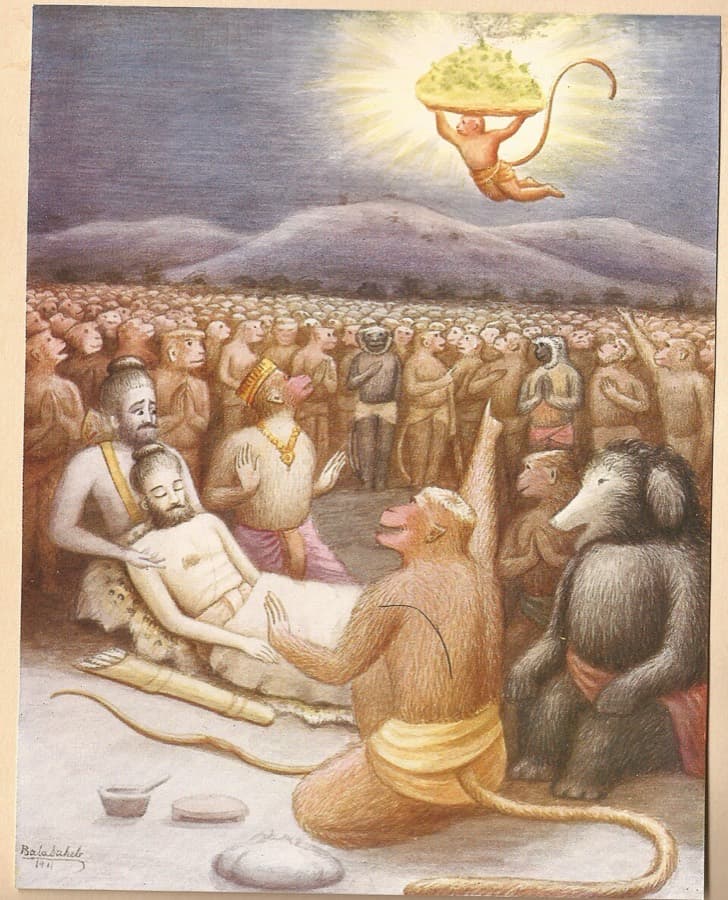
- The Dronagiri Mountain: Symbolizes that Hanuman does not merely deliver a single solution; when he couldn't identify the specific Sanjeevani herb, he lifted the entire mountain, demonstrating boundless initiative and unconditional dedication.
- The Five Faces (Pañcamukha Hanumān): According to the Parāśara Saṃhitā, Hanuman assumed a colossal five-faced form to extinguish five directional lamps simultaneously and vanquish Ahiravana in Patala:
- East: Hanumān (Vanara) — grants purity of mind and removal of sins.
- South: Narasiṃha — grants fearlessness and victory over enemies.
- West: Garuḍa — destroys evil spirits and poisons.
- North: Varāha — bestows health, prosperity, and rain.
- Sky: Hayagrīva — grants supreme knowledge and liberation.
Canonical Daily Practice & Sadhana
Beginner / Household Practice
- Daily Recitation of the Hanuman Chalisa: Chanted daily in the morning or twilight, especially on Tuesdays and Saturdays.
- Offering to Maruti: Offering water, fresh tulsi leaves, and roasted chickpeas with jaggery (gur-chana).
- Moola Mantra: $$\text{Om Hanumate Namaḥ}$$
Intermediate / Spiritual Healing Sadhana
- 108 Chants of the Chalisa: Undertaken during times of acute personal, familial, or physical crisis.
- Tuesday Fasting (Vrata): Eating only one meal of fruits and milk, visiting a consecrated Hanuman shrine to offer red hibiscus flowers and sindoor paste mixed with jasmine oil.
- Recitation of the Bajarang Baan: A rigorous vow-taking prayer invoking the sacred oaths of Sri Rama to ward off acute fear, nightmare disturbances, and psychic negativity.
Wisdom Graph: Divine Associations
- Vāhana
- Flies through the cosmic atmosphere by his own divine wind-power (Vāyu-vega); often depicted carrying Rama and Lakshmana on his shoulders
- Sacred animals
- vanara (monkey warriors)cow (protected by Maruti)
- Sacred flowers
- red hibiscus (japā-kusuma)marigold (genda)arka flowers (Calotropis)aparājitā (blue pea)
- Sacred plants
- tulasī (garlands of tulsi leaves offered to Hanuman)arka plantdarbha grass
- Sacred trees
- peepal (aśvattha — where circumambulation pacifies Saturn's malefic effects)banyanśamī
- Offerings
- sindūra (vermilion paste applied all over the murti with jasmine oil / Chameli tel)boondi laddusgur-chana (jaggery and roasted gram)tulsi malabetel leaf garland (vetrilai malai in Tamil tradition)
- Weapons / emblems
- Gadā (golden mace of supreme physical power)Mountain of Sanjeevani herbsVajra-deha (adamantine physical body that repels all celestial weapons)
- Sacred colours
- radiant vermilion orange (sindūr)deep crimson redbright saffron
- Sacred numbers
- 581140108
Principal Temples
- Sankat Mochan Hanuman Temple16th c. CE (Founded by Goswami Tulsidas)📍 Varanasi, Varanasi, Uttar Pradesh, IndiaThe sacred site on the Assi river where Tulsidas had the divine vision of Hanuman and composed the Hanuman Chalisa; famous for the besan laddus offered to the deity
- Yantrodharaka Anjaneya Temple15th c. CE (Sri Vyasatirtha)📍 Hampi, Bellary, Karnataka, IndiaPerched upon a hill above the Tungabhadra in Kishkindha; houses the rare murti of Hanuman seated in padmasana inside a six-pointed yantra with twelve monkeys holding tails
- Salasar Balaji1754 CE (Pt. Mohandas Maharaj)📍 Salasar, Churu, Rajasthan, IndiaHouses a unique, self-manifested murti of Hanuman with a rounded face, beard, and mustache, drawing millions of pilgrims annually
- Mehandipur Balaji TempleAncient site; 11th–12th c. CE stone temple📍 Mehandipur, Dausa, Rajasthan, IndiaWorld-renowned sanctuary dedicated to Balaji (child Hanuman), Bhairava, and Pretraj Sarkar, famous for spiritual healing and relief from psychic distress
- Namakkal Anjaneyar Temple8th c. CE (Adiyaman / Pandya rock-cut)📍 Namakkal, Namakkal, Tamil Nadu, IndiaColossal 18-foot monolithic single-stone open-air standing Hanuman with hands in anjali mudra, gazing directly across at the Narasimhaswamy hill temple
- Hanuman Garhi10th c. origin; rebuilt 18th c. CE (Nawab Safdarjung endowment)📍 Ayodhya, Ayodhya, Uttar Pradesh, India76-step fortified hilltop fortress temple guarding the city of Ayodhya; custom dictates pilgrims must visit Hanuman Garhi before entering the Ram Janmabhoomi
- Kashtbhanjan Dev Hanuman Mandir1848 CE (Gopalanand Swami, Swaminarayan tradition)📍 Sarangpur, Botad, Gujarat, IndiaRenowned as the 'Crusher of Sorrows' (Kashtbhanjan); the murti is depicted crushing a small demoness (representing Kaliyuga and evil spirits) beneath his foot
- Suchindram Thanumalayan Anjaneyar16th c. CE (Nayaka / Travancore)📍 Suchindram, Kanyakumari, Tamil Nadu, IndiaMonolithic 22-foot colossal granite Anjaneya carved from a single boulder, buried in 1740 to protect it from invasion and re-erected in 1930
Festivals
- Hanumān JayantīCaitra Pūrṇimā (Mar–Apr in North India) / Mārgaśīrṣa Amāvāsyā (Tamil Nadu) / Vaiśākha Bahula Daśamī (Telugu states) · 1–41 days (with Hanuman Deeksha in Andhra/Telangana)Commemorates the appearance day of Sri Hanuman; observed with sunrise recitations of the Hanuman Chalisa, mass sindoor offerings, and wrestling demonstrations
- Weekly Maṅgalavāra & Śanivāra VrataObserved every Tuesday (for Mars) and Saturday (for Saturn); devotees fast, visit Hanuman temples, and offer garlands of betel leaves, arka flowers, and mustard-oil lamps
- Dīpāvalī (Hanumān Pūjā / Naraka Caturdaśī)Kārttika Kṛṣṇa CaturdaśīCelebrated in Gujarat and western India to invoke Hanuman's protection before Lakshmi Puja
Primary Scriptural Sources
- Sundarakāṇḍa (Vālmīki Rāmāyaṇa, Book 5)epicc. 5th–4th c. BCE68 chapters solely dedicated to Hanuman's heroic reconnaissance mission to Lanka, his discovery of Mother Sita, and the demonstration of vanara valor
- Hanumān Chālīsābhakti1576 CEGoswāmī Tulsīdās40 Awadhi chaupais composed in Varanasi celebrating Hanuman's divine virtues, widely acknowledged as the most frequently recited prayer in northern India
- Rāmcaritmānasbhakti1574 CEGoswāmī TulsīdāsThe Sundara and Lanka Kandas present Hanuman as the personification of selfless service and ocean of wisdom
- Saṅkaṭamocana Hanumānāṣṭakastotra16th c. CEGoswāmī TulsīdāsEight stanzas recounting Hanuman's heroic deeds, recited to ward off acute misfortune and physical danger
- Parāśara SaṃhitāpuranaPancharatra canonical scripture detailing Hanuman's cosmic genealogy, his marriage to Suvarchala (solar manifestation), and the worship of Panchamukha Hanuman
- Hanumān BāhukastotraGoswāmī TulsīdāsComposed by Tulsidas when stricken by agonizing physical illness, petitioning Hanuman's healing grace
Sources & provenance
- 📖Supporting referenceOtherValmiki Ramayana
- 📖Supporting referenceOtherRamcharitmanas
- 📖Supporting referenceOtherHanuman Chalisa
- 📖Supporting referenceOtherParasara Samhita
- 📖Supporting referenceOtherAdhyatma Ramayana