Sacred Facts · At a Glance
- Gender
- male
- Vahana
- Garuḍa (as Vishnu); chariot in Rath Yātrā
- Weapon
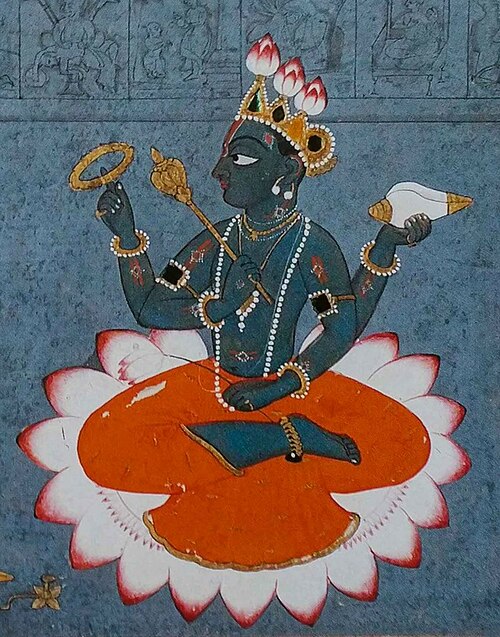
- Sudarśana Cakra
- Sacred Number(s)
- 56 · 9
- Sacred Colours
- black (Jagannāth)white (Balabhadra)yellow (Subhadrā)
- Sacred Flowers
- lotus · tulsi · champaka
- Sacred Trees
- neem (dāru-brahman — sacred wood of Jagannath)
- Sacred Offerings
- mahāprasāda (56 varieties, chhappan bhoga) · anna-brahma rice
- Sacred Animals
- elephant · cow
- Sacred Plants
- tulsi · neem (the murtis are carved from neem wood)
Primary Scriptures
4 sources- Skanda Purāṇa — Puruṣottama Māhātmyapurana
- Brahma Purāṇapurana
- Sārala Mahābhārata (Oriya)epicSāralā DāsaComposed 15th c. CE
- JagannāthāṣṭakamstotraĀdi Śaṅkarācārya
Jagannath
Lord of the Universe
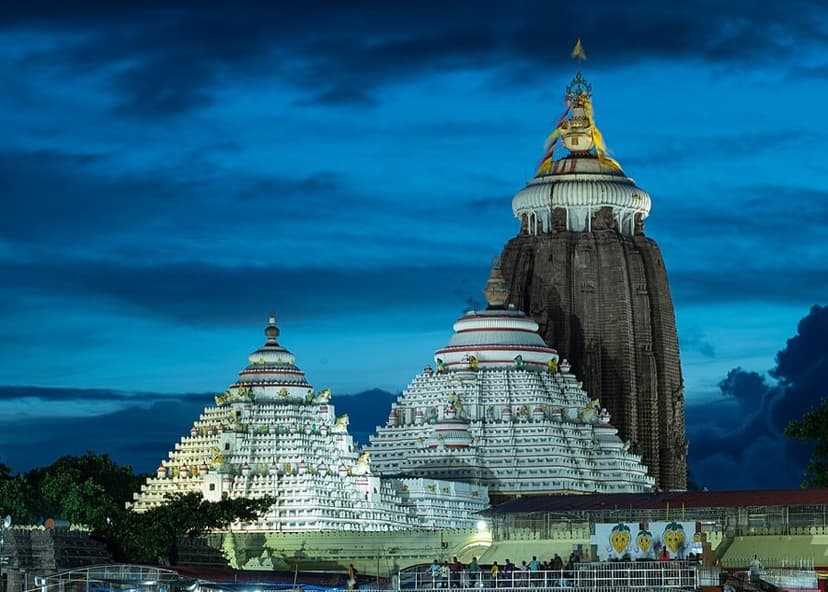
Jagannath (Odia: ଜଗନ୍ନାଥ; Jagan-nātha, "Lord of the Universe") is the presiding deity of Puri — worshipped in the distinctive form of a stylised wooden torso and face that makes his iconography unlike any other major Hindu deity. He is the Odisha T0 anchor, one of the four Char Dham, and the theological centre of a regional tradition that gave Vaishnavism the Gaudiya movement of Chaitanya, produced Jayadeva's Gita Govinda, and sustained one of the most continuous devadasi-ritual traditions in India until its 20th-century decline.
The wooden triad
The Puri sanctum enshrines three deities together — Jagannath (black), Balabhadra (white), and Subhadra (yellow) — plus a fourth aniconic Sudarshan (red wooden disk-column). The images are carved from daru (neem wood) and are periodically replaced in the Nabakalebara (new-body) ritual, which occurs when an astrological year contains two months of Ashadha — at 8, 12, or 19-year intervals, most recently in 2015. The wood-carving and consecration ritual, conducted by specific priestly families (daitapatis, of tribal-adivasi descent), preserves a visibly non-Brahminical ritual layer inside the larger Brahminical temple complex. Eschmann, Kulke & Tripathi (1978) argue that this is evidence for Jagannath's origin as a Sabara tribal deity subsequently assimilated to Krishna-Vaishnavism.
Historical development
The present temple was built between 1135 and 1161 CE by Anantavarman Chodaganga Deva of the Eastern Ganga dynasty, rebuilding on an earlier shrine attested from at least the 9th century. Under Anangabhima Deva III (1211–1238), Jagannath was declared the actual sovereign of the Kalinga state, with the human king acting as the deity's rauta (first servitor) — a theological-political arrangement that Kulke (1993) has shown was unique among medieval Hindu polities in placing the temple idol formally above the human ruler. This constitutional fiction remains active: the present Gajapati Maharaja of Puri sweeps the chariot at Rath Yatra in symbolic ritual subordination.
Ratha Yatra
The annual Ratha Yatra (Chariot Festival) of Jagannath, Balabhadra, and Subhadra — Ashadha Shukla Dwitiya (June–July) — is the single most famous Hindu festival outside the Ganesha-Diwali-Durga Puja cycle. The three deities are carried from the main temple to the Gundicha Temple 3 km away on three enormous wooden chariots (Jagannath's Nandighosha is 45 feet tall, 16 wheels), pulled by tens of thousands of devotees. The festival's English-language name "juggernaut" derives from Orientalist misreading of Jagannath's chariot. Rath Yatras are now replicated in cities across India and globally, but the Puri original remains the theological reference point. Frédérique Apffel Marglin (1985) documented the devadasi ritual tradition, which ended in the late 20th century as the last hereditary devadasis died.
Ritual economy
Daily ritual includes the famous Mahaprasada — temple food cooked in up to 750 earthen pots over wood fires, served to ~30,000 people daily, and treated theologically as the body of the Goddess Lakshmi who is said to cook for her husband Jagannath. The temple administers through the Shree Jagannatha Temple Administration (statutory under Odisha state law) while maintaining a distinctive sevayat priesthood divided into 36 named services (nijog), each hereditary.
Why this entry matters
Jagannath is the Odisha T0 anchor, a Char Dham, the canonical tribal-to-Vaishnava assimilation case, and the site of the most institutionally and theologically studied medieval Hindu temple. Eschmann, Kulke & Tripathi (1978) alone gives this entry Tier 1 footing sufficient for VERIFIED promotion after Advisory Council sign-off.
Wisdom Graph: Divine Associations
- Vāhana
- Garuḍa
- Sacred animals
- elephantcow
- Sacred flowers
- lotustulsichampaka
- Sacred plants
- tulsineem (the murtis are carved from neem wood)
- Sacred trees
- neem (dāru-brahman — sacred wood of Jagannath)
- Offerings
- mahāprasāda (56 varieties, chhappan bhoga)anna-brahma rice
- Weapons / emblems
- Sudarśana Cakra
- Sacred colours
- black (Jagannāth)white (Balabhadra)yellow (Subhadrā)
- Sacred numbers
- 569
Principal Temples
- Jagannath Puri12th c. CE (Ganga dynasty)📍 Puri, Puri, Odisha, IndiaChar Dham; Ratha Yātrā site
- ISKCON Jagannath Delhi📍 Punjabi Bagh, Delhi, Delhi, India
Festivals
- Ratha YātrāĀṣāḍha Śukla Dvitīyā (June–July) · 9 daysWorld's largest chariot procession
- Snāna YātrāJyeṣṭha Pūrṇimā (June)Ritual bath; deity falls ill for 15 days (anavāsar)
- NabakaḷebaraEvery 8–19 years; deities replaced with new neem wood images
Primary Scriptural Sources
- Skanda Purāṇa — Puruṣottama Māhātmyapurana
- Brahma Purāṇapurana
- Sārala Mahābhārata (Oriya)epic15th c. CESāralā Dāsa
- JagannāthāṣṭakamstotraĀdi Śaṅkarācārya
Sources & provenance
- 📜Primary sourceBookAnncharlott Eschmann, Hermann Kulke, and Gaya Charan Tripathi (eds.). The Cult of Jagannath and the Regional Tradition of Orissa (1978) pp. 1–597Manohar; the foundational multi-author scholarly compendium, still definitive
- 📜Primary sourceBookHermann Kulke. Kings and Cults: State Formation and Legitimation in India and Southeast Asia (1993) pp. 8–62Manohar; the 'royal chapel' reading of Jagannath and state-formation in medieval Orissa
- 📜Primary sourceArticleFrédérique Apffel Marglin. Wives of the God-King: The Rituals of the Devadasis of Puri (1985)Oxford University Press; devadasi tradition at Jagannath
- 📜Primary sourceBookPeter Ronald deSouza and Jagannath Mohanty (eds.). Jagannatha Puri: The Lord, His Temple, and the Religious Tradition (2010)B. R. Publishing
- 📜
- 📜