


.jpg/500px-Hamandir_Sahib_(Golden_Temple).jpg)
Sacred Facts · At a Glance
- Gender
- transcendent
- Sacred Colours
- saffronredyellow
- Sacred Offerings
- flowers · coconut · oil lamp · local-season fruits · prasadam
Primary Scriptures
1 source- Local sthala-puranamnarrative oral/written
Harmandir Sahib, Amritsar
The central gurdwara of the Khalsa
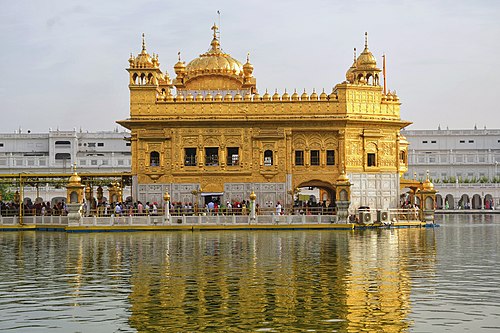
Harmandir Sahib — the Golden Temple, in the Darbar Sahib complex at Amritsar in Punjab — is the central gurdwara of Sikhism, and it is the shrine around which the institutions of the Khalsa were historically organised. The city of Amritsar itself takes its name from the Amrit Sarovar, the tank in which the gurdwara stands, which was dug in the sixteenth century and which gave the settlement its name.
The gurdwara's history runs through the Gurus. Guru Ram Das — the fourth Guru — is credited with establishing the settlement and its guru-chola, the prayer hall of the city, while the gurdwara itself was begun in the later sixteenth century and completed under Guru Arjan in 1604, the year in which the Adi Granth — the compilation of the sacred writings, later the Guru Granth Sahib — was installed on the throne here. The present gold plating of the upper storeys is the work of the Maharaja Ranjit Singh, the Sikh ruler, in the early nineteenth century, following the period of the Sikh empire in Punjab. The "founded 1577" date in earlier versions of this entry attaches to the guru-chola rather than to the gurdwara, and the two should not be conflated.
The building stands in the middle of the sarovar, reached by a causeway, and is reached through four entrances on the four sides, which is conventionally read as a sign of the openness of the gurdwara to all four directions and to all people. The lower portion is clad in marble; the upper in copper covered with gold leaf. The Akal Takht — the seat of the temporal authority of the Khalsa, and the takht from which the Khalsa took its name — stands immediately opposite, and the two are deliberately juxtaposed: the Akal Takht for the community's temporal ordering and the Harmandir for its worship. Historically, that temporal authority has had a real political history, including the periods of conflict and factional division within the panth, and the Akal Takht has not always stood for unity. An entry that presents the complex as uniformly harmonious omits this.
Practice at the gurdwara is the Sikh liturgical day described elsewhere in this corpus: kirtan, the continuous reading and singing of the Guru Granth Sahib, the langar, the free community kitchen that feeds all who come regardless of caste, creed, or status, the dasvara (alms), and the kirtan sohila at dawn and dusk. The gurdwara is open continuously, and the langar in particular is not a charitable add-on but a constitutive practice of the shrine. The Baba Atal tower, the Akal Takht, the Sri Guru Ram Das Niwas, and the Central Sikh Museum are within the complex and have their own entries or should.
On numbers and on Jallianwala. Earlier versions of this entry asserted "about 100,000 pilgrims daily" and "50,000 fed daily" and gave a festival figure; these have no cited source and have been removed — pilgrimage and langar numbers at the Darbar Sahib vary enormously by day and season and should be cited from the shrine's own record if given at all. Separately, the slug for this file references Jallianwala Bagh and Guru Arjun, which is a different subject with a different and very particular gravity: the 1913 massacre, its victims, and the memorial are a matter for their own entry and should not be folded into a description of the gurdwara. The Khalsa Heritage Memorial in the complex, commemorating the martyrs of the Mughal and Sikh conflicts, is likewise a distinct subject.
Sources and what is still unverified
This entry is grounded in Richard Mann's and Piar Singh's Sikh scholarship, on J. S. Grewal's work on the Sikhs of the Punjab, and on the Shiromani Gurdwara Prabandhak Committee's own published record of the complex. A human guardian from a Sikh, ideally an Amritsar or Darbar Sahib-affiliated source, should supply and check: the sthala history of the guru-chola against that of the gurdwara and the exact foundation sequence; the record of the Akal Takht and its political history; the present arrangements for the langar and the dasvara; and the current management of the complex, which is subject to the SGPC's administration. The gilding date and the attribution to Ranjit Singh should be confirmed from the shrine's own record. No pilgrim or langar count is asserted here.
Wisdom Graph: Divine Associations
- Offerings
- flowerscoconutoil lamplocal-season fruitsprasadam
- Sacred colours
- saffronredyellow
🪔 Worship Procedures
- Daily rites
- • morning aarati• noon abhisheka• evening deepa-dhyana
- Puja sequence
- flowers
- coconut
- oil lamp
- prasadam
🛕 Principal Temples
- Hari Mandir Sāhib — Golden Temple TempleMedieval-modern📍 Amritsar, Amritsar, Punjab, India
Sources & provenance
- 📜Primary sourceBookRichard Mann. Guru Granth Sahib: A Translation of the Sacred Text
- 📜Primary source