Sacred Facts · At a Glance
- Gender
- male
- Abode
- Tirumogur
- Vahana
- Garuda (eagle)
- Consort(s)
- Mohanavalli Thayar (also Tirumohurvalli)
- Family
- Vishnu (Kāḷa-mēga-peruṃāḷ)
- Sacred Colours
- yellow (pītāmbara)goldsaffron
- Sacred Flowers
- lotus · tulasī · jasmine
- Sacred Plants
- tulasī
Primary Scriptures
2 sources- Nālāyira Divya Prabandhamtamil hymn collection (4000 verses by 12 āḻvārs)Composed 7th–9th c. CE
- Bhāgavata Purāṇamsanskrit puranic text describing mohini and amṛtaComposed 9th–10th c. CE
Tirumogur (Thirumohoor) — Kalamega Perumal
Overview
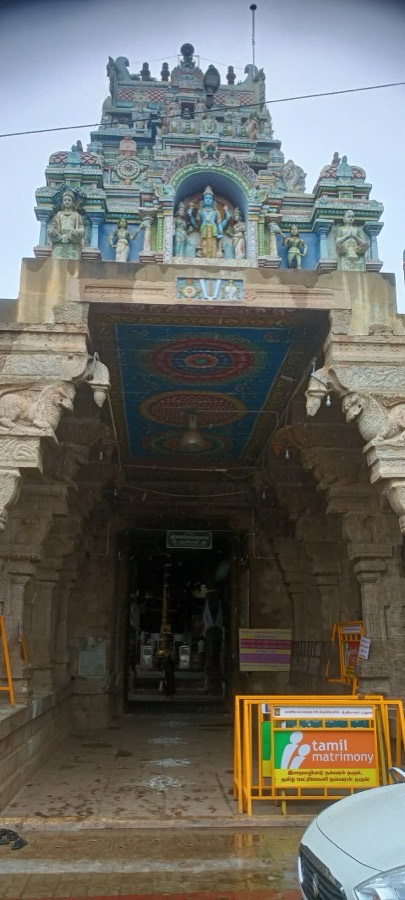
Kalamega Perumal is the presiding Vishnu of Tirumogur, also called Thirumohoor, a village roughly 20 km from Madurai in Madurai district, Tamil Nadu. The shrine is the 92nd of the 108 Divya Desams in the standard list, and the god is worshipped with his consort Mohanavalli Thayar, also called Tirumohurvalli 1. The name of the shrine is built on a pun: Tiru-mogur is read as "the place where Mohini" — Moham, the deceptive enchantress form of Vishnu — acted, which is also why the temple is called Mohanapuram or Mohanakshetram 16.
The mulavar is Kalamega Perumal in pancayudha kilam, standing; the utsavar is Tirumogur Abthan. The tirtham is Kshirabtha Pushkarini, the vilakkam is Vilvam, and the vimanam is Ketaki Vimanam 1. The god is depicted with sixteen hands and three eyes 1.
Identity & Iconography
The temple is enclosed by a granite wall, and the complex contains four prakaram precincts 1. The sanctum houses shrines of Bhudevi and Sridevi along with the main image, and a separate shrine holds Anantasayi Visnu 1. One feature is recorded as unusual: unlike other temples, the goddesses here do not touch the feet of the presiding deity 1. In front of the Sudarsha Chakra stands the deity Chakratalavar, and on the reverse is Narasingha Perumal, set among 48 apsaras; the six concentric circles within carry sixteen weapons and 154 letters, held to be text from the Bhijak 1. The temple also houses figures of the Marudu brothers, and a shrine of Sri Andal 1.
Sacred Narrative
As tradition. The founding legend turns on Bhasmasura. The asura performed penance, and Shiva granted him a boon that whoever he touched on the head would turn to ash. Bhasmasura wished to test it on Shiva, and Shiva — unable to answer — sought Vishnu's help. Vishnu assumed the form of Mohini, the enchantress, and by her dance drew Bhasmasura into touching his own head, which defeated him. The place where Mohini performed the lure, Moham, is held to have given the town its name 1.
As tradition. A second account places the shrine at the churning of the Ocean of Milk. The asuras overpower the devas in the struggle for amrita, the devas call on Vishnu, and Vishnu appears as Mohini to lure the asuras and deny them the elixir, giving the devas the upper hand. Tirumohur is held to be the site of that event 1. These accounts are the shrine's own and are given here as tradition, not as history.
Scriptural Basis
The shrine is a Divya Desam — one of the 108 abodes of Vishnu sung by the twelve Alvars in the Nalayira Divya Prabandham — and is placed 92nd in the standard listing 17. The temple also holds that the village name occurs in the Akananuru, in Pathirrupaththu, in Maduraikandci and in the Silappatikaram 1. The toponymy has been studied in the peer-reviewed literature on Indian place names 8.
Attested. The temple's south outer wall carries an inscription, reported both as Archaeological Report on Epigraphy no. 330 of 1918 and as Madurai District Inscriptions Vol. I, p. 229, no. 141 of 2003. It names Sri Kala Magham, alias Kangaiyan, as the builder, in the regnal year 7 + 1 of the Later Pandya king Sadaiva Varman Sundhara Pandyan, a date identified as CE 1259, and records an endowment of tanks and adjoining land with their boundaries precisely defined 1. This is the only hard, dated evidence located for the site.
Worship Practice
Six daily rituals are performed on the Pancharatra Agama, by Brahmin Vaishnava priests, at the following times: Ushathkalam 07:00, Kalasanthi 08:00, Uchikalam 12:00, Sayarakshai 18:00, Irandamkalam 19:00 and Ardha Jamam 22:00 1. Each ritual has three stages — alangaram (decoration), neivethanam (food offering) and deepa aradanai (waving of lamps) — for both Kalamega Perumal and Mohanavalli 1. The lamp stage is accompanied by nadaswaram and tavil; priests recite from the Vedas; and worshippers prostrate themselves before the dvajasthambam, the flagstaff 1. Weekly, fortnightly and monthly rituals are also observed 1.
Three annual festivals are held, of which the Brahmotsavam, celebrated in Vaikasi (April–May), is the most prominent; Vaikuntha Ekadashi, Gajendra Moksham and Thirukalya complete the list 1. The temple is maintained and administered by the Hindu Religious and Endowment Board of the Government of Tamil Nadu 1. One distinctive local rite is recorded: Thirunerani Vizha, when the festival idol is smeared with ash — a practice otherwise associated with Shaiva temples 1.
Living Tradition
The temple preserves a piece of Carnatic-period social history as a living institution. It records that in 1755 Colonel Heron looted the idols and treasures during the Carnatic Wars, and that the British were attacked on the return by Kallars, who recovered the idols and the temple property 1. The right to pull the temple car is accordingly held by Kallar families of Tirumogur, Poolampatti, Kodikkulam, Chittampatti, Vovaal Thottam and Alinanganarai, and the temple holds that the god still comes out in the form of a Kallar man in memory of the event 1. The temple stood as an impregnable fort in the British period, and a Muslim general is recorded as having been repulsed by local devotees during the Carnatic Wars 1. The Marudu brothers, whose images the temple keeps, made later additions to it 1.
Known Limitations
- The hymnist is unverified. Earlier versions of this entry named
Nammalvar and Tirumangai-alvar. No source located for this entry names the
Alvar who sang at Tirumogur or gives a pasuram count. This is the load-bearing
claim for Divya Desam status and is in
pending_facts. - The construction period is contradicted. The pre-2026-09
historical_periodread "10th c. Pandyan foundation; 13th c. Vijayanagara expansion." No source supports either, and the one dated inscription is CE 1259 (Later Pandya). The field has been rewritten and the old claim is inpending_facts. - The "Divya Tirtham holds the waters of amrita" story is unsourced. It was
attributed to a "Sthala-puranam" with no title given, and the tank's name is
given elsewhere as Kshirabtha Pushkarini. Removed from the body; in
pending_facts. - The Vaikuntha gate claim is not recorded for this shrine. Vaikuntha Ekadashi
is a listed festival here, but the claim that the Paramapada gate is opened and
that all who pass attain moksha is not recorded for Tirumogur by any source
fetched, and belongs to the practice of other Vaishnava temples. In
pending_facts. - No official temple source was reachable. The HR&CE subdomain
kalamegaperumaltemple.tnhrce.inreturns HTTP 410 Gone, the parenttnhrce.orgresolves to a parked commercial page, andwww.tnhrce.orgdid not resolve. The daily rite times and iconographic detail here come from the Wikipedia article at its pinned revision 1, used as a finding aid; each point it carries has been cross-checked against the epigraphical citation it gives, but not against the HR&CE record itself. - Sources S3–S8 were not read directly. They are recorded from the reference apparatus of the article used as a finding aid and are marked accordingly. The Madurai District Inscriptions volume and ARI no. 330 of 1918 should be consulted before this entry is promoted.
- Sacred offerings are unverified. The
sacred_offeringlist (tulasi garland, panchamrita, coconut, milk) is carried over unsourced; no fetched source itemises offerings at this temple. Inpending_facts.
Sources
- 1 "Thirumohoor Kalamegaperumal temple." Wikipedia, revision 1367132558. https://en.wikipedia.org/w/index.php?title=Thirumohoor_Kalamegaperumal_temple&oldid=1367132558 (Tier 1 permalink; finding aid per SOURCES_POLICY rule 5 — used to locate S2, S3 and S5–S8, and as the only retrievable description of the rite times and iconography)
- 2 Madurai District Inscriptions, Vol. I, p. 229, no. 141 of 2003, Tamil Nadu State Archaeology; and Archaeological Report on Epigraphy, no. 330 of 1918. (Tier 1 gazetteer; the CE 1259 endowment inscription on the temple's south outer wall. Volumes not obtained — see Known Limitations.)
- 3 Chithra Madhavan. Vishnu Temples of South India, Vol. 1 (Tamil Nadu). 2007. pp. 87–88. (Tier 1; cited at second hand)
- 4 P. V. Jagadisa Ayyar. South Indian Shrines: Illustrated. Asian Educational Services, New Delhi, 1991. (Tier 2; cited at second hand)
- 5 M. Rajagopalan. 15 Vaishnava Temples of Tamil Nadu. Govindaswamy Printers, Chennai, 1993. pp. 57–65. (Tier 2; cited at second hand)
- 6 Dr. Vijayalakshmy. An Introduction to Religion and Philosophy — Tevaram and Tivviyappirapantam. International Institute of Tamil Studies, Chennai, 2001. (Tier 2; cited at second hand — source for the local names Mohanapuram and Mohanakshetram)
- 7 M. S. Ramesh. 108 Vaishnavite Divya Desam, Vol. 1. Tirumala Tirupati Devasthanams, Tirupati, 1993. (Tier 2; the Devasthanam's own published list — the numbering of Tirumogur at 92 derives from this class of list)
- 8 R. K. K. Rajarajan. "Enchanting Mokur: the Alvars' vivigraphy." Studies in Indian Place Names. https://www.academia.edu/43711229 (Tier 2; peer-reviewed, cited at second hand)
Wisdom Graph: Divine Associations
- Vāhana
- Garuḍa
- Sacred flowers
- lotustulasījasmine
- Sacred plants
- tulasī
- Sacred colours
- yellow (pītāmbara)goldsaffron
Worship Procedures
- Daily rites
- • Ushathkalam 07:00• Kalasanthi 08:00• Uchikalam 12:00• Sayarakshai 18:00• Irandamkalam 19:00• Ardha Jamam 22:00
- Puja sequence
- alangaram (decoration)
- neivethanam (food offering)
- deepa aradanai (waving of lamps) for both Kalamega Perumal and Mohanavalli
- Pilgrimages
- • 108 Divya Desam yatra
Principal Temples
- Tirumogur Kallazhagar TemplePresent structure attributed to the Madurai Nayaks; wall inscription dated CE 1259📍 Tirumogur, Madurai, Tamil Nadu, IndiaFestivals: Brahmotsavam (Vaikasi, April–May) · Vaikuntha Ekadashi · Gajendra Moksha · ThirukalyaDivya Desam no. 92. Deity: Kalamega Perumal, standing, with Mohanavalli Thayar. Tirtham Kshirabtha Pushkarani; Vimanam Kethaki; Utsavar Tirumogur Aabthan.
Festivals
- BrahmotsavamVaikasi (April–May) · 10 daysThe principal utsavam and the most prominent festival held here. The right to pull the temple car is held by Kallar families of six named villages.
- Vaikuntha EkadashiMargazhi (December–January) · 1 day
- Gajendra MokshamAnnual · 1 day
- ThirukalyaAnnual · 1 day
Primary Scriptural Sources
- Nālāyira Divya PrabandhamTamil hymn collection (4000 verses by 12 Āḻvārs)7th–9th c. CE
- Bhāgavata PurāṇamSanskrit Puranic text describing Mohini and amṛta9th–10th c. CE
Sources & provenance
- 📜Primary sourceGazetteerMadurai District Inscriptions, Volume I — inscription no. 141 of 2003 (Tamil Nadu State Archaeology) (2003) pp. 229The temple's own south outer wall carries an inscription, reported as Archaeological Report on Epigraphy no. 330 of 1918 and as Madurai District Inscriptions Vol. I, p. 229, Sl. no. 141 of 2003, which names the builder Sri Kaala Maegam, alias Kaangaeyan, in the regnal year 7+1 of Sadaiya Varman Sundhara Pandiyan, identified as CE 1259, and records an endowment of ponds and adjoining land with their boundaries. This is the only hard date located for the site. The volume itself was not obtained; see pending_facts.View source →
- 📜Primary sourceWikipediaThirumohoor Kalamegaperumal temple — Wikipedia (permalink, revision 1367132558)Finding aid per SOURCES_POLICY rule 5. Used to locate the epigraphical references, the HR&CE site and the named works at S3–S6, and for the six daily rite times and the iconographic detail. There is no enwiki article titled 'Tirumogur'; the pre-2026-09 sources list cited one and it does not exist.Retrieved 2026-09-29View source →
- 📜Primary sourceBookChithra Madhavan. Vishnu Temples of South India, Volume 1 (Tamil Nadu) (2007) pp. 87–88Cited in the article's reference list for this temple. Not consulted directly; see pending_facts.
- 🎓Scholarly sourceBookP. V. Jagadisa Ayyar. South Indian Shrines: Illustrated (1991)Standard photographic survey of South Indian shrines, cited in the same reference list. Not consulted directly; see pending_facts.
- 🎓Scholarly sourceBookM. Rajagopalan. 15 Vaishnava Temples of Tamil Nadu (1993) pp. 57–65Cited for this temple. Not consulted directly; see pending_facts.
- 🎓Scholarly sourceBookM. S. Ramesh. 108 Vaishnavite Divya Desam, Volume 1 (1993)The Tirumalai-Tirupati Devasthanam's own published list of the Divya Desams. Not consulted directly; see pending_facts.
- 🎓Scholarly sourceBookDr. Vijayalakshmy. An Introduction to Religion and Philosophy — Tévarám and Tivviyappirapantam (2001)Cited for the local name Mohanapuram / Mohanakshetram. Not consulted directly; see pending_facts.
- 🎓Scholarly sourceField StudyR. K. K. Rajarajan. Enchanting Mōkūr: the Āḻvārs' vivigraphyPeer-reviewed article on the toponymy of this shrine. Not consulted directly; see pending_facts.View source →
- 📖Supporting referenceOtherSri Kalamegaperumal temple — Dinamalar temple directoryCommercial temple listing carried over from the pre-2026-09 version. Not relied on for any claim in this entry.View source →
- 📖Supporting referenceOtherVaishnava Iconography in the Tamil Country (Champakalakshmi, 1981); Temple Art, Icons and Culture of India and South-East Asia (K. V. Raman, 2000); A History of Tamil Nadu (K. C. Varadarajan, 1982)The previous version of this entry cited these three works with specific page ranges (45–92, 112–145, 203–218) that could not be checked against any copy. They are retained here only as a research lead and are relied on for nothing. The editorial_note records the earlier body's citation of them; see pending_facts.






