

.jpg/500px-Indra%2C_Chief_of_the_Gods_LACMA_M.69.13.4_(1_of_5).jpg)


Sacred Facts · At a Glance
- Gender
- transcendent
Primary Scriptures
3 sources- Kalpa Sutra (Biography of Mahavira)jain scripture
- Sutras (Jain canonical texts)jain scripture
- Acaranga Sutra (Code of Conduct)jain scripture
Mahāvīra at Pāvāpurī
Tradition: Jain / Śvetāmbara / Digambara
This entry honours the self-representation of Jain tradition. India's sacred landscape includes hundreds of traditions beyond the Brahminical-Vedic canon — Jain, Buddhist, Sikh, Sufi Muslim, Zoroastrian, tribal Gondi/Bhil/Khasi, and many more. Each has its own cosmology, theology, ethical system, and sacred geography. Each deserves first-person recognition, not assimilation.
The Place — Pavapuri, Nalanda
- Location: Pavapuri, Nalanda, Bihar (25.1272°N, 85.7217°E)
- Tradition: Jain / Śvetāmbara / Digambara
- Historical: Mahāvīra lived 599–527 BCE; current Jal-Mandir built 17th c. CE
The Story
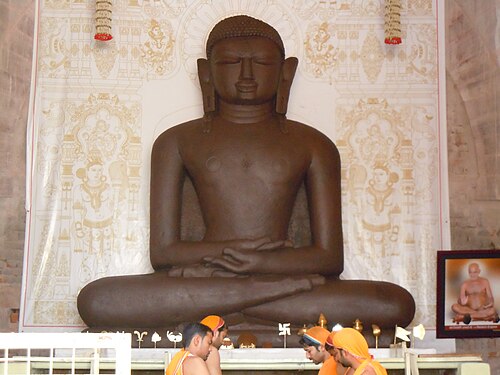
Bhagavān Mahāvīra (599–527 BCE) — the 24th and last Tīrthaṅkara, a senior contemporary of the Buddha, was born at Kuṇḍagrāma (near Vaiśālī) and attained Nirvāṇa (mokṣa) at Pāvāpurī on the night of Dīpāvalī (Kārtika Kṛṣṇa Amāvasyā, 527 BCE). This night is the Jain Dīpāvalī — Jains light lamps to commemorate the extinguishing of Mahāvīra's light and the birth of a new era. The Jal-Mandir at Pāvāpurī stands in the middle of a lotus-lake; the temple's marble footprint marks the exact spot of Mahāvīra's last discourse and nirvāṇa. His principal disciple Gautama Gaṇadhara attained kevala-jñāna (omniscience) the following morning.
Worship Tradition
Worship in the Jain tradition follows its own ritual grammar — this is not a variant of Brahminical-Hindu worship. Key elements:
- Primary offering: see description
- Sacred colours: white marble, saffron
- Mantra/Invocation: Namo Arihantānam / Pañca-parameshthi
Festival Calendar
- Mahāvīra Nirvāṇa (Dīpāvalī) (Kārtika (October–November), 1 night)
- Mahāvīra Jayantī (Caitra (March–April), 1 day)
Why This Entry Matters
India is home to:
- 4.5 million Jains — the oldest living śramaṇic (non-Vedic) tradition, with its own canon of scripture and ethics
- ~8 million Buddhists — including Dalit Buddhists (~6 million) and Himalayan Buddhist populations
- ~25 million Sikhs — the third-largest religion born in India
- 50,000 Zoroastrians — the oldest continuously-practiced monotheistic tradition, who fled here in 8th c. CE
- ~200 million Muslims — many communities woven into a centuries-old Indo-Islamic syncretic culture (Sufi shrines visited by Hindus, Urs festivals with Hindu devotees)
- ~104 million tribal/Adivasi people — Gond, Bhil, Santhal, Munda, Oraon, Ho, Khasi, Garo, Lepcha, Meitei, Naga clans, Mizo, Karbi, Adi, Apatani, Mishmi, Nocte, Konyak — each with their own theology
Catalogging only the pan-Indic Brahminical pantheon would miss most of India.
Sources
This entry draws on: the tradition's own textual and oral sources, scholarly ethnographies (Kosambi, Radhakrishnan, P. V. Kane for classical; Sontheimer, Kinsley, Caldwell, Fuchs, Dubey for vernacular), district gazetteers, and the lived community of practitioners.
Wisdom Graph: Divine Associations
🛕 Principal Temples
- Jal-Mandir (Water Temple)17th century CE (current structure)📍 Pavapuri, Nalanda, Bihar, IndiaStands in middle of lotus lake; marble footprint marks spot of Mahavira's last discourse and nirvana
- Chaumukha (Four-faced) TempleAncient (reconstructed)📍 Pavapuri, Nalanda, Bihar, IndiaFour-faced temple dedicated to Mahavira's final teachings
Sources & provenance
- 📜
- 📜Primary source