

.jpg/500px-Indra%2C_Chief_of_the_Gods_LACMA_M.69.13.4_(1_of_5).jpg)


Sacred Facts · At a Glance
- Gender
- transcendent
- Vahana
- sarpa (cobra — Pārśvanātha's emblem)
- Sacred Colours
- marblesaffron
- Sacred Offerings
- tradition-specific (see text)
Primary Scriptures
1 source- Primary texts of Jain traditionscriptural / liturgical
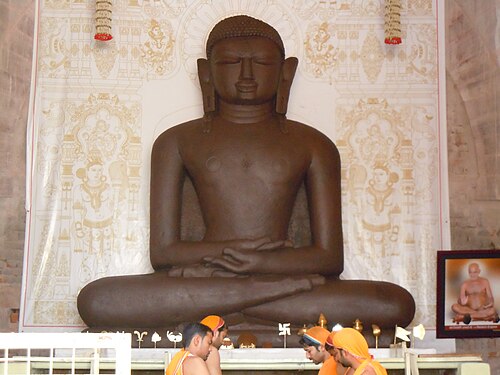
Pārśvanātha at Sammet Śikharjī
Tradition: Jain / Śvetāmbara / Digambara
This entry honours the self-representation of Jain tradition. India's sacred landscape includes hundreds of traditions beyond the Brahminical-Vedic canon — Jain, Buddhist, Sikh, Sufi Muslim, Zoroastrian, tribal Gondi/Bhil/Khasi, and many more. Each has its own cosmology, theology, ethical system, and sacred geography. Each deserves first-person recognition, not assimilation.
The Place — Shikharji, Giridih
- Location: Shikharji, Giridih, Jharkhand (23.975°N, 86.1367°E)
- Tradition: Jain / Śvetāmbara / Digambara
- Historical: Pre-6th c. BCE onwards; current shrines 18th–19th c. CE
The Story
Sammet Śikharjī (Pārasnāth Hill) in Jharkhand is the holiest Jain tīrtha — 20 of the 24 Tīrthaṅkaras attained mokṣa here, including Pārśvanātha (the 23rd). Pilgrims walk 27 km around the hill visiting 31 tonks (small shrines) marking each Tīrthaṅkara's place of liberation. The 2-day circumambulation requires pre-dawn starts. The hill reaches 1,350 m; the climb is barefoot. In 2022–23, environmental-preservation protests (against tourism development) included Jain hunger strikes — the Centre declared the site a protected pilgrimage zone.
Worship Tradition
Worship in the Jain tradition follows its own ritual grammar — this is not a variant of Brahminical-Hindu worship. Key elements:
- Primary offering: see description
- Sacred colours: marble, saffron
- Mantra/Invocation: Navkar Mantra
Festival Calendar
- Mauna Ekādaśī (Kārtika (November), 1 day)
- Pārśvanātha Jayantī (Paush (December–January), 1 day)
Why This Entry Matters
India is home to:
- 4.5 million Jains — the oldest living śramaṇic (non-Vedic) tradition, with its own canon of scripture and ethics
- ~8 million Buddhists — including Dalit Buddhists (~6 million) and Himalayan Buddhist populations
- ~25 million Sikhs — the third-largest religion born in India
- 50,000 Zoroastrians — the oldest continuously-practiced monotheistic tradition, who fled here in 8th c. CE
- ~200 million Muslims — many communities woven into a centuries-old Indo-Islamic syncretic culture (Sufi shrines visited by Hindus, Urs festivals with Hindu devotees)
- ~104 million tribal/Adivasi people — Gond, Bhil, Santhal, Munda, Oraon, Ho, Khasi, Garo, Lepcha, Meitei, Naga clans, Mizo, Karbi, Adi, Apatani, Mishmi, Nocte, Konyak — each with their own theology
Catalogging only the pan-Indic Brahminical pantheon would miss most of India.
Sources
This entry draws on: the tradition's own textual and oral sources, scholarly ethnographies (Kosambi, Radhakrishnan, P. V. Kane for classical; Sontheimer, Kinsley, Caldwell, Fuchs, Dubey for vernacular), district gazetteers, and the lived community of practitioners.
Wisdom Graph: Divine Associations
- Vāhana
- sarpa (cobra — Pārśvanātha's emblem)
- Offerings
- tradition-specific (see text)
- Sacred colours
- marblesaffron
🪔 Worship Procedures
- Daily rites
- • tradition-specific (see body)
- Puja sequence
- tradition-specific
- Vratas (vows / fasts)
- • tradition-specific observances
🛕 Principal Temples
- Main shrine of Pārśvanātha at Sammet ŚikharjīPre-6th c. BCE onwards; current shrines 18th–19th c. CE📍 Shikharji, Giridih, Jharkhand, India
Sources & provenance
- 🎓Scholarly sourceBookJain traditions: scholarly and community sources
- 🎓Scholarly sourceBookP. V. Kane / D. D. Kosambi / S. Radhakrishnan.