

Sacred Facts · At a Glance
- Gender
- male
Primary Scriptures
0 sourcesNo primary scriptures are catalogued for this entry yet. If you know of scriptural references we have missed, please contribute them.
Sundareswarar
The Handsome Lord
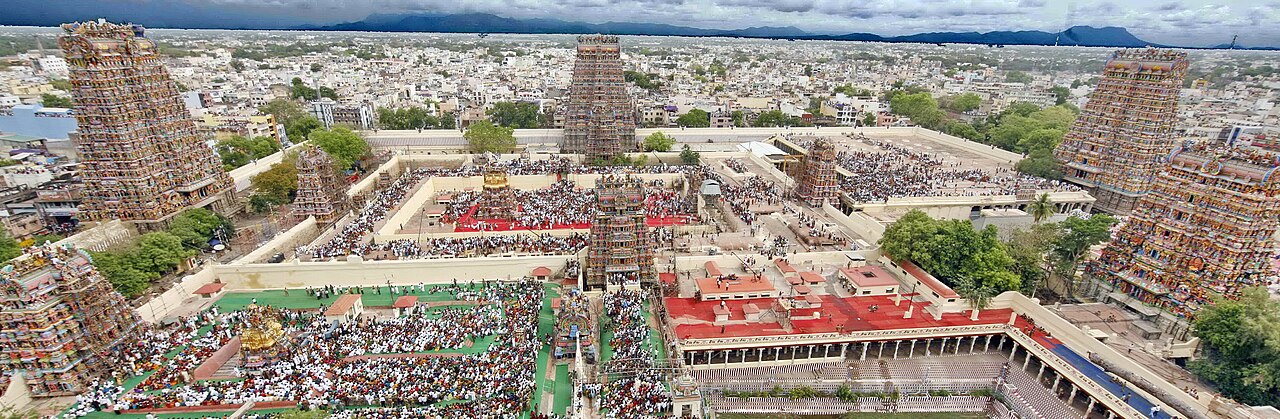
Sundareswarar (Tamil: சுந்தரேஸ்வரர்; Sanskrit: Sundareśvara, "the Beautiful Lord") is the Shaiva half of the Meenakshi-Sundareswarar complex — the consort of the presiding goddess Meenakshi and, in the Madurai mythic cycle, the divine identity of the Pandya king Sundara Pandya. Where Meenakshi embodies goddess-as-sovereign, Sundareswarar embodies the Shaiva theology of divine kingship, enacted through the Thiruvilaiyadal ("sacred games") tradition: 64 miracles performed by Shiva in and around Madurai, catalogued in Paranjothi Munivar's 17th-century Thiruvilaiyadal Puranam and in Nambi Andar Nambi's earlier Chola-era compilation.
Iconography and identity
In the main Madurai sanctum, Sundareswarar is worshipped as a svayambhu (self-manifest) lingam; no anthropomorphic mula-vigraha exists in the garbha-griha. The processional utsava-murti (Chokkanatha) depicts him as a handsome young king, crowned and holding the parasu (axe) and mriga (deer), with Meenakshi to his right — the inverse of most South Indian couples, where the goddess stands on the left. Harman (1989) reads this as a ritual assertion that Meenakshi occupies the senior, ruling position in the complex.
Relationship to the Nataraja cycle
Sundareswarar is the Madurai form of the same Shiva who dances in Chidambaram as Nataraja. The 5th of the 64 Thiruvilaiyadal episodes describes Shiva's dance in Madurai's Velli Ambalam (Silver Hall), parallel to Chidambaram's Kanaka Sabha and Thirvalangadu's Ratna Sabha — making Madurai one of the five canonical Pancha Sabhai dance-halls of Shiva (see Younger 1995 for the comparative framework). Inside the Madurai temple, the Ootrakkadai Mandapa enshrines a bronze of Nataraja with his right foot lifted — a reversal of the standard left-foot-lifted pose, attributed in local tradition to a Pandya king's request.
The 64 sacred games
The Thiruvilaiyadal Puranam narrates 64 miracles — from reversing the Vaigai's course, to feeding sugarcane to an elephant, to competing in Tamil composition with the Sangam poets. These episodes function, as Shulman (1980) argues, as a mythology of sovereignty: Shiva establishes Madurai's cosmogonic and political legitimacy through repeated acts of play-kingship. Each episode is still attached to a specific named site within or near the temple, making the inner corridors of the Madurai complex a kind of walking-text of the Puranam.
Ritual life
The core ritual of Sundareswarar's worship is the nightly Palli-arai — the "bedchamber" ceremony in which a silver utsava-murti of Sundareswarar is processed from his shrine to Meenakshi's to sleep beside her, attended by five women who sing lullabies. This daily re-enactment of the divine marriage is among the most distinctive liturgical features of any Indian temple and the practical reason the complex is treated as a single indivisible deity. At dawn a reverse procession returns the murti to his own sanctum.
In the Chithirai festival
During the 12-day Tirukalyanam culminating on Chaitra Purnima, Sundareswarar in his form as Chokkanatha marries Meenakshi before lakhs of pilgrims (see Meenakshi and Chithirai Thiruvizha). The groom's-side procession emerges from his sanctum; Meenakshi's emerges from hers; they meet under the Pottramarai Kulam, and the temple's priests conduct a live marriage rite that simultaneously recapitulates the mythic wedding and, historically, coronated the Pandya king of the day as the human Sundara Pandya.
Wisdom Graph: Divine Associations
- Vāhana
- Nandi
Sources & provenance
- 📜Primary sourceBookWilliam P. Harman. The Sacred Marriage of a Hindu Goddess (1989) pp. 44–97
- 📜Primary sourceBook
.jpg/500px-Kallazhagar_(31).jpg)


