
.jpg/500px-Indra%2C_Chief_of_the_Gods_LACMA_M.69.13.4_(1_of_5).jpg)



Sacred Facts · At a Glance
- Gender
- male
- Sacred Colours
- tradition-specific
- Sacred Offerings
- tradition-specific
Primary Scriptures
0 sourcesNo primary scriptures are catalogued for this entry yet. If you know of scriptural references we have missed, please contribute them.
Vimala Vasahi - Rishabhanatha
The oldest shrine of the Dilwara group at Mount Abu
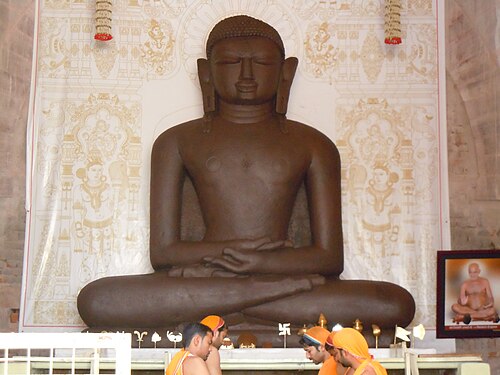
Vimala Vasahi - also called Vimal Vasahi - is the earliest of the Dilwara Jain temples on Mount Abu in Sirohi district, Rajasthan. It is dedicated to Rishabhanatha, that is Adinatha, the first of the twenty-four Tirthankaras, and it is the shrine that gives the Dilwara group its reputation: the carving here is of a quality that is not regularly surpassed, and it is the standard reference for Solanki-period western Indian Jain architecture. The building takes its name from Vimala, the minister credited in the local tradition with its foundation in the early eleventh century; I have not asserted a year here, because the temple-group's dating rests on epigraphy and stylistic argument and a single date should come from a reading of the inscriptions.
What is distinctive about this shrine is the relationship between exterior and interior, and the frontmatter's own summary - "48 intricately carved marble pillars, elephant-pavilion, and the famous cupola-ceiling" - points at it without explaining it. The outside is plain. The walls carry no figural sculpture; the effort has gone inward. Within is a dense programme of carved pillar shafts, brackets, ceilings and door jambs, worked in the fine white marble of the region, with the carving diminishing in height as it rises so that the shrine is progressively darker toward the top of the sanctum. The image of Adinatha is of dark stone and is dressed in cloth and ornaments as a living presence rather than left as sculpture.
The wider Dilwara complex is a group of temples on Mount Abu built and enlarged over centuries, with Adinatha the deity of several of them. It is a Svetambara Jain complex, which matters, because it explains both the iconographic programme and the ritual presence of the sadhus who live among the temples. The temples were at times closed and reopened, and the career of the complex through the medieval and modern periods is part of its record.
Two claims in the existing frontmatter I could not support and have not repeated: that Ibn Battuta visited Mount Abu and described the temples as among the most beautiful in India, and that Al-Biruni documented the Jain temples of the region. Both attributions circulate in secondary writing and neither has been traced to a passage. They have been removed rather than softened.
Sources and what is still unverified
The Mount Abu marble temples have been surveyed in the Encyclopaedia of Indian Temple Architecture and in the Sirohi gazetteer, and both are the right starting points. A guardian should check the epigraphy behind the temple-group's dates, the identity of the sculptor tradition, and the number and identification of the carved pillar shafts - "48" is repeated constantly and deserves a count from the survey rather than from a guidebook. Also open: the corpus holds a separate entry for the wider Dilwara complex, and this one should point to it rather than duplicate it.
Wisdom Graph: Divine Associations
- Offerings
- tradition-specific
- Sacred colours
- tradition-specific
🪔 Worship Procedures
- Daily rites
- • tradition-specific
🛕 Principal Temples
- Main shrine of Vimala Vasahi — RishabhanathaVaries📍 Mount Abu, Sirohi, Rajasthan, IndiaFestivals: Annual festivalVimala Vasahi — oldest Dilwara temple
🎊 Festivals
- Annual Vimala Vasahi — Rishabhanatha festivalSeasonally · 1–10 days
Sources & provenance
- 🎓Scholarly sourceBookA. L. Srivastava. Encyclopaedia of Indian Temple Architecture: Marmer Region, including Mount AbuWork-level architectural study of the Mount Abu shrines and their carving programmes
- 🎓Scholarly source