Sacred Facts · At a Glance
- Gender
- male
Primary Scriptures
0 sourcesNo primary scriptures are catalogued for this entry yet. If you know of scriptural references we have missed, please contribute them.
The 24 Tirthankaras — the Jinas of the present half-cycle
Overview
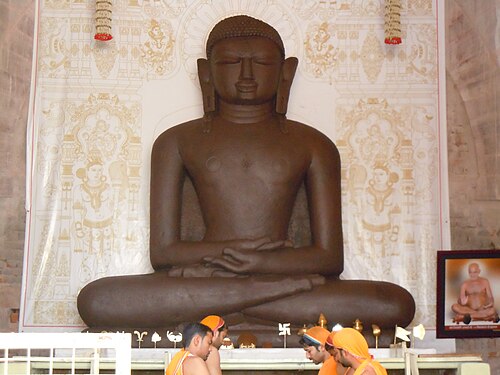
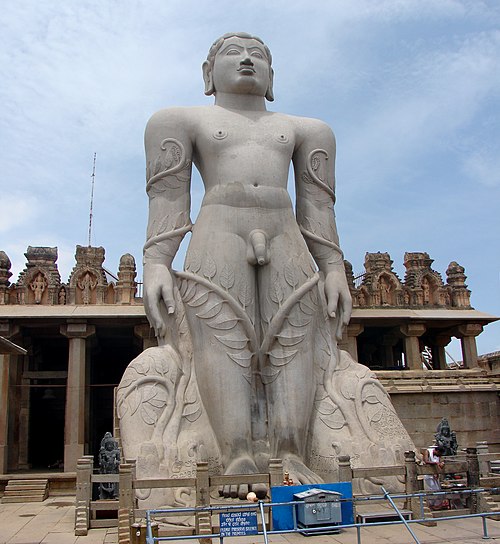
A Tirthankara (tīrthaṅkara) is literally a ford-maker: the founder of a tīrtha, a fordable passage across saṃsāra, the sea of interminable birth and death 278. The term is also rendered "Teaching Gods", "Ford-Makers", "Crossing Makers" and "Makers of the River-Crossing" 11. Jains hold that a Tirthankara is a saviour and supreme preacher of the dharma who has conquered saṃsāra on their own and made a path for others to follow; having understood the true nature of the self, the Tīrthaṅkara attains kevala jñāna, omniscience, and provides a bridge for others to cross from saṃsāra to moksha 18.
The number 24 is cosmological, not commemorative. Jain cosmology holds that time has no beginning or end and moves like the wheel of a cart, divided into an ascending half-cycle (utsarpiṇī) and a descending half-cycle (avasarpiṇī), said to be the one now. In each half exactly 24 Tirthankaras appear in this part of the universe, and there have been infinitely many in the past 7. The first of the present half is Rishabhanatha, credited within the tradition with formulating and organising human society; the 24th and last is Mahavira 71.
The most important thing to say about these figures is what they are not. The Jain scholar Pragya Jain's peer-reviewed study of the Digambara attitude states that Jainism "stands out as trans-theist for its unusual approach toward the belief in God's existence": there is no interventionist almighty entity that created the universe and none to destroy it or punish the evils of the world, and the Jina has conquered any desire to interfere, create or destroy 3. Every soul has the potential to become one 1. A Tirthankara is therefore not a creator, not a judge, and not a saviour from an external threat — the crossing is something each soul must make, and the Tirthankara's function is to have made the crossing possible and to point the way 38.
Identity & Iconography
Each of the 24 is identified by a fixed emblem (lañchhana) and colour. The table below is reproduced from the finding aid's canonical list 1, which cites Jaina Iconography 6 and an emblems reference 9. Read it with the caveat in Known Limitations: its underlying citations are partly unretrieved.
| No. | Name | Emblem | Colour |
|---|---|---|---|
| 1 | Rishabhanatha (Ādinātha) | Bull | Golden |
| 2 | Ajitanātha | Elephant | Golden |
| 3 | Sambhavanātha | Horse | Golden |
| 4 | Abhinandananātha | Monkey | Golden |
| 5 | Sumatinātha | Flamingo | Golden |
| 6 | Padmaprabha | Padma (lotus) | Red |
| 7 | Suparśvanātha | Swastika | Green |
| 8 | Chandraprabha | Crescent moon | White |
| 9 | Puṣpadanta (Suvidhinātha) | Crocodile or makara | White |
| 10 | Śītalanātha | Kalpavṛkṣa (Digambara); Śrīvatsa (Śvetāmbara) | Golden |
| 11 | Śreyāṅsanātha | Rhinoceros | Golden |
| 12 | Vasupūjya | Buffalo | Red |
| 13 | Vimalanātha | Boar | Golden |
| 14 | Anantanātha | Porcupine (Digambara); falcon (Śvetāmbara) | Golden |
| 15 | Dharmanātha | Vajra | Golden |
| 16 | Śāntinātha | Antelope or deer | Golden |
| 17 | Kunthunātha | Goat | Golden |
| 18 | Araṇātha | Nāndāvarta or fish | Golden |
| 19 | Māllīnātha | Kalasha | Blue |
| 20 | Munisuvrata | Tortoise | Black/dark blue |
| 21 | Nāminātha | Blue lotus | Golden |
| 22 | Neminātha | Shankha (conch) | Black/dark blue |
| 23 | Pārśvanātha | Snake | Green |
| 24 | Mahāvīra | Lion | Golden |
Two rows record a sectarian disagreement rather than a settled emblem — Śītalanātha's and Anantanātha's — and both sects' answers are given 1. I have not silently chosen one.
The posture matters too. The finding aid reports that 21 of the 24 are said to have attained moksha in the kayotsarga, the standing meditation posture, while Rishabhanatha, Neminātha and Mahāvīra are said to have done so in the padmāsana, the lotus position 711. Neither book was retrieved; cite at those pages.
Cort's Framing the Jina 2 is the study that would explain who is permitted to make such an image and why, and it is the reference a human should consult before treating this table as more than a canonical list. I read its catalogue record only.
Sacred Narrative
The lives of the 22 non-historical Tirthankaras follow a formulaic pattern rather than individual biography: birth into a royal family, a period of worldly life, renunciation (dīkṣā), asceticism leading to omniscience (kevala jñāna), and final liberation (nirvāṇa) 1. Texts such as the Kalpa Sūtra detail these lives 1. This entry does not narrate 24 individual stories, because I have no source for 24 individual stories — see pending_facts.
A Tirthankara organises the fourfold saṅgha — male and female monastics, śrāvakas and śrāvikās 710 — and his teachings form the basis of the Jain canons. The inner knowledge of a Tirthankara is believed to be perfect and identical in every respect and to contain no contradictions; the degree of elaboration of the teaching varies with the spiritual advancement of the society at the time 1. I have invented no chapter or verse numbers for any of the 24.
Only two of the 24 are broadly accepted as historical: Pārśvanātha (23rd, c. 8th century BCE) and Mahāvīra (24th, c. 6th century BCE) 7811. Pārśvanātha is understood as a predecessor who preached the chaturyama dharma, the fourfold restraint; Mahāvīra is seen as a reformer and final systematiser of Jain thought who re-established the Jain monastic and lay community on Pārśvanātha's teachings, notably adding celibacy as the fifth great vow 7. That single doctrinal addition is the clearest structural difference between the two historical figures, and it is sourced.
Rishabhanatha holds a unique position and I flag it rather than resolve it: within the tradition he is credited with founding human civilisation, teaching agriculture, law and social order. Some scholars have speculated on a pre-historical link, pointing to nude standing figures and the bull motif on seals of the Indus Valley civilisation (c. 3300–1300 BCE) as possible — though unproven — evidence of a proto-Jain or proto-Rishabha cult 1. The finding aid's own qualifier is "though, unproven", and it is preserved.
Scriptural Basis
The Jain texts actually named in the sources I reached are limited, and I report only these. The Ṇamokāra mantra, the fundamental prayer dedicated to the Pañca-Parameṣṭhi (the five supreme beings), begins Ṇamō arihantāṇaṁ, "obeisance to the arihants" 12. The Tattvārtha Sūtra, a major Jain text, lists 16 observances that lead to the bandha (bondage) of the tīrthaṅkara-nāma-karma, the karma that raises a soul to that supreme status — among them purity of right faith, reverence, observance of vows without transgression, ceaseless pursuit of knowledge, charity, austerities according to capacity, and devotion to omniscient lords and to the scriptures 1.
The Rāyapaseṇiyasutta, a Śvetāmbara canonical text, is named by name in Restifo's peer-reviewed study, which describes it as containing ritual re-enactment of the Jina's biography 4. I cite the text by name only and give no chapter, verse or folio, because I read the abstract of 4 and not the article.
The Kalpa Sūtra, the Uttarādhyayana Sūtra and Nemicandra's Trilokasara were this entry's previous three sources: entries. They have been removed. The Kalpa Sūtra is mentioned in the finding aid 1; the other two were listed with no page, edition or verse, none verified. Their removal is a decision about citation standards, not a claim that they are unimportant.
Worship Practice
Restifo's study establishes something that corrects a common assumption: performance has long been recognised as a meaningful component in the worship of the Jina, and ritual re-enactment of the Jina's biography was familiar to Jains already in the early centuries of the common era — it was not confined to the five auspicious events (kalyāṇakas) 4. In the Śvetāmbara Rāyapaseṇiyasutta this re-enactment forms part of a greater spectacle evoking a variety of aesthetic emotions, including erotic emotion, in the audience of monks 4.
Her argument is one I can report because I read it in the abstract, and it is a substantive scholarly position rather than a fact about the world: the more splendid and aesthetically pleasing a devotee's expression of devotion, the more efficacious it is believed to be; and the significance of the aesthetic element for laypeople lies in their temporary transformation into gods and goddesses, since celestial beings as the paradigmatic enjoyers (bhoktṛ) of sensual pleasures spend their life-spans relishing joy and rapture 4. This is one scholar's interpretive and ethnographic argument, not a consensus, and I present it as such.
A further point of doctrine, cited by the finding aid without a page: the Tirthankaras' grace is said to be available to all living beings regardless of religion 5. Whether any Jain community in India actually teaches or practises that is a question about practice rather than doctrine, and I have no source bearing on it.
The finding aid also describes the samavāsara, the pavilion in which a Tirthankara preaches after attaining omniscience: devas (heavenly beings) erect it, and devas, humans and animals assemble to hear 9. The three-tier structure reported — a silver level for vehicles, a gold level where all animals reside, and a topmost level of precious gems for kings, their families, the devas and the ascetics — and the claim that humans and animals hear the Tīrthaṅkara's speech in their own language, with no unhappiness for miles around 910, are reported here as the finding aid renders a citation whose own bibliographic entry it garbles. Treat that paragraph as the weakest evidence in this entry.
Regional Forms
This concept is not regional, and describing it that way would be the error. Jainism holds one canon of 24; the Digambara, Śvetāmbara and Sthānakvasi traditions divide on practice and doctrine, and the sources I reached show them differing on specific emblems (§ Identity & Iconography), not on the list of the 24 or their order 1.
What differs is how the Jina is worshipped. Cort's Framing the Jina 2 and Restifo's study 4 both treat Jain devotional practice as contested and internally debated rather than uniform, and Restifo's central argument is precisely that the Digambara and Śvetāmbara traditions do not simply share one "Jain worship" that can be described once 4. The tradition: field retains all four labels, and that is a statement about the diversity of the living tradition, not a claim that each sect has its own 24.
I am not a source on contemporary Jain practice in any specific community. I consulted no Digambara or Śvetāmbara temple, no Jain publication in Gujarati, Hindi or Prakrit, and no fieldwork study of a living Jain congregation. SOURCES_POLICY rule 4 expects community-published material alongside external scholarship for living traditions; the community half of that is missing here, and this entry must not be read as describing how Jains worship today.
Temple(s) / Seats
Every Tirthankara has one or more kṣetra — a tīrtha, a ford, and the root of the word "Tirthankara" itself — where he or she is held to have attained moksha 27. The finding aid names specific attributions: 20 Tirthankaras attained moksha on Mount Shikharji, in present-day Jharkhand; Rishabhanatha on Mount Ashtāpada (Mount Kailash); Vasupūjya at Champāpuri, Bihar; Neminātha on Mount Girnar, Gujarat; and Mahāvīra at Pawāpurī, near modern Patna 1. It also reports that Rishabhanatha founded the Ikṣvāku dynasty, from which 21 others rose over time, while Munisuvrata (20th) and Neminātha (22nd) belonged to the Harivamsa dynasty 9.
The Shikharji attribution is the one to be careful with. The finding aid cites it to Marie-Henriette Altheim's Essence of Spiritualism 9 — a book by a modern spiritual teacher, not a Jain canonical or scholarly source, and one whose own bibliography entry in the finding aid is garbled. I report it because it is the traditional attribution, and I mark the source quality rather than dropping the claim.
The previous version of this entry listed five pilgrimage sites with temple counts, dedications, build dates and pilgrimage durations — including "863 temples" at Palitana, "22 temples with 14 carvings of Tirthankaras" at Shikharji, "12 temples dedicated to Mahavira" at Pawāpuri, and "Built 11th-13th c. by Vimal Shah" for the Dilwara temples at Mount Abu. I could not source a single one of those numbers or dedications and have cut the entire section. Those are precisely the invented-count failures this corpus exists to remove. No temple should be added here until a Jain temple-trust page, an ASI record or a scholarly gazetteer supports it — and no ASI record could be checked, because asi.nic.in was unreachable from this machine.
Mahāvīra, Neminātha, Pārśvanātha and Rishabhanatha are each large enough subjects to carry their own entries, and the corpus rule is one god one entry. I have not written them and I make no claim whether such entries already exist or whether they would duplicate this one. Reconciling a 24-member canon entry with individual deity entries is a human editorial task.
Known Limitations
- The emblem table is a canonical list, not verified iconography. Its upstream citations are Britannica (not retrieved), Doniger's Encyclopedia of World Religions p. 550 (not retrieved), and a work the finding aid cites as "Vijay K. Jain 2015" while garbling in its own bibliography 169. It is internally consistent and it is the entry's core content, so I reproduced it rather than deleting it — but a human must check it against Jaini and Fischer 6 before relying on it.
- No source I reached was retrieved in full except two abstracts. Cort 2, Flügel 5, Jaini and Fischer 6, Dundas 7, Jaini 8, the garbled 9, Balcerowicz 10, Zimmer 11, Sangave 12 and Champat Rai Jain 13 are all cited at the pages the finding aid attributes to them, not at pages I verified.
- Two of the three best sources are paywalled and one was bot-walled. Cort's Framing the Jina is the essential work on Jina images and I read only its Crossref record. Restifo is open access but mdpi.com returned an "Access Denied" wall, which per protocol means NOT FETCHED, not unreadable. Flügel's SOAS copy did not connect.
- I did not read a single Jain primary text. No Āgama, no Kalpa Sūtra, no Tattvārtha Sūtra, no Rāyapaseṇiyasutta. Where I name one it is because a source named it. I invented no chapter, verse, folio or stanza number anywhere in this entry, and where a source gave only a page range I stopped at the page range.
- The samavāsara paragraph is the weakest evidence here, and I have said so in place rather than dropping it, because dropping a claim while leaving the citation looks like tidiness rather than judgement.
- The Shikharji "20 Tirthankaras" attribution comes from a modern spiritual teacher's book, not from a canonical or scholarly source.
- Removed as unsourced: the whole five-site pilgrimage list with its temple counts, dedications and durations; the "2400+ years" span; the corrupt eight-entry table that stood in the previous body, which listed wrong names at wrong numbers (Dorikhyagr as 7th, Amitinatha as 8th, Jinaprabhrit as 9th), had columns shifted so that symbols and colours fell under the wrong Tirthankara, gave "Atharva" and "Mandara" as emblems, duplicated "Nami" as both 21st and 23rd, and ended with the hedge "Note: This list continues from traditional canonical sources" where it should have begun; the three unsourced
sources:entries; a brokenmantra:string with||separators and an unbalanced quote; and ageo:block containing a literal YAMLundefinedkey with a fabricated "Chandrapratara (17th), symbol: Cat (Biḍāla)" entry at Sonagiri. - A structural inconsistency remains in the frontmatter. The key is
category: "deity-circuit", which is not one of the contract's categories, sovalidate-enrichment.mjsfalls back to its generic section test rather than the deity one. The section set here follows the deity contract. A human should decide whether this entry is a deity entry or a circuit/canonical-set entry and normalise the key. - The corpus rule is one god one entry, and this entry covers 24. It is defensible as a canon record rather than a deity record, but that is a judgement for a human, and the frontmatter
gender: maleis wrong on its face for a set that includes Nāminātha. I have not changed the field because I do not know what the schema permits for a canonical set.
Sources
- 1 "Tirthankara", Wikipedia, revision 1374198605 — https://en.wikipedia.org/w/index.php?title=Tirthankara&oldid=1374198605. Finding aid only (SOURCES_POLICY rule 5); retrieved in full, its references followed to 5–13.
- 2 John E. Cort, Framing the Jina: Narratives of Icons and Idols in Jain History, Oxford University Press, 2009, ISBN 978-0-19-538502-1, DOI 10.1093/acprof:oso/9780195385021.001.0001. Tier 1. Catalogue record only — paywalled.
- 3 Pragya Jain, "Jains and the Jina: Exploring the Digambara Attitude", Religion Compass (Wiley), 2025, DOI 10.1111/rec3.70027. Tier 1, peer-reviewed. Publisher abstract read in full; full text not retrieved.
- 4 Aleksandra Restifo, "Aesthetic Pleasure in the Worship of the Jina: Understanding Performance in Jain Devotional Culture", Religions (MDPI), vol. 10, no. 4, article 251, 2019, DOI 10.3390/rel10040251. Tier 1, peer-reviewed, open access. Publisher abstract read in full; full text NOT retrieved (mdpi.com bot-wall).
- 5 Peter Flügel, "The Jaina Cult of Relic Stūpas", Numen, vol. 57, nos. 3–4, pp. 389–504, 2010, DOI 10.1163/156852710X501351. Tier 1, peer-reviewed. Not retrieved; SOAS eprints copy unreachable.
- 6 Jyontindra Jain and Eberhard Fischer, Jaina Iconography, Iconography of Religions: Indian Religions, Part 12, E. J. Brill, 1978, ISBN 978-90-0405259-8. Tier 1. Not retrieved.
- 7 Paul Dundas, The Jains, 2nd ed., Routledge, London and New York, 2002, ISBN 0-415-26605-X. Tier 1. Not retrieved; cited at pp. 19–20, 30–31, 212, 221 as the finding aid attributes.
- 8 Upinder Jaini, The Jains, 3rd ed., Vikas Publishing House, 1998. Tier 1. Not retrieved; cited at p. 10 as the finding aid attributes. See
pending_factson possible duplication with 7. - 9 Cited in the finding aid at pp. 151, 181–208 and 200 for emblems, colours, dynasties and the samavāsara; publisher not established — the finding aid's own bibliography entry is garbled, giving the author as "Rajneesh Jain", publisher "Krishna Prakashan Media", title Essence of spiritualism. Tier 1 by the finding aid's short-sfn key; do not rely on any claim resting on it alone.
- 10 Piotr Balcerowicz, Jainism and the Definition of Religion, Hindi Granth Karyalay, Mumbai, 1st ed., 2009, ISBN 978-81-88769-29-2. Tier 1. Not retrieved; cited at pp. 16–17.
- 11 Heinrich Zimmer, Philosophies of India, George Allen and Unwin, 1953, pp. 182–183, 212. Tier 1. Not retrieved.
- 12 Vishnudas B. Sangave, Jainism: The Oldest Living Religion, Himalaya Publishing House, 2006, pp. 16, 164, 169–170. Tier 2. Not retrieved. The finding aid spells the surname "Sangave"; usual romanisation "Sanghvi".
- 13 Champat Rai Jain, Jainism, Christianity and Science, The Indian Press, Allahabad, 1930, p. 3 — https://archive.org/details/JainismChristianityAndScience. Tier 2. Not retrieved, but a stable public-domain scan is supplied so a human can reach it without a paywall.
Wisdom Graph: Divine Associations
Sources & provenance
- 📜Primary sourceWikipediaTirthankara (finding aid only; its own references were followed)FINDING AID ONLY (SOURCES_POLICY rule 5). Retrieved in full to read its reference list; every claim below is attributed to the underlying scholarly work, not to this article. The article's emblems table cites Encyclopaedia Britannica, Wendy Doniger's Encyclopedia of World Religions (1999) p. 550, and Vijay K. Jain (2015) pp. 181-208; Britannica was NOT retrieved. Leads NOT used as evidence: Jas Burgess, Indian Antiquary vol. 2 (1874); Vensus A. George, Paths to the Divine (2008); Lawrence A. Babb, Absent Lord (1996) p. 5; Marie-Henriette Altheim, Rajneesh Jain, Essence of Spiritualism (2016) p. 4; a Hindustan Times travel column; the Jains University emblem PDF (site unreachable); and jainworld.com, which the emblems table cites for all 24 names.Retrieved 2026-09-29View source →
- 📜Primary sourceBookJohn E. Cort. Framing the Jina: Narratives of Icons and Idols in Jain History (2009)THE key monograph for how Jina images are made, framed and worshipped in Jain history, and for the Jain argument about who is entitled to iconography. Metadata confirmed via Crossref; full text paywalled and NOT retrieved. The finding aid cites this as Cort's 1953 article reprinted in book form. Cited as the study a human must consult, NOT as evidence for any specific claim below.Retrieved 2026-09-29
- 📜Primary sourceArticlePragya Jain. Jains and the Jina: Exploring the Digambara Attitude (2025)PEER-REVIEWED; the source for this entry's most important conceptual point. The publisher abstract, read in full, states that Jainism 'stands out as trans-theist for its unusual approach toward the belief in God's existence'; that there is no interventionist almighty creator and none to punish the evils of the world; that the Jina has overcome any desire to interfere, create or destroy; and that the three virtues grounding the worshipper-worshipped relationship are non-attachment (vitaragatā), omniscience (sarvajñatā) and promulgation of the right path (hitopadeśitā). Full text not retrieved.Retrieved 2026-09-29
- 📜Primary sourceArticleAleksandra Restifo. Aesthetic Pleasure in the Worship of the Jina: Understanding Performance in Jain Devotional Culture (2019)PEER-REVIEWED, open access; the source for the worship-practice material. The publisher abstract, read in full via Crossref, establishes that performance has long been recognised as a meaningful component in Jina worship; that ritual re-enactment of the Jina's biography was familiar to Jains already in the early centuries CE and was NOT confined to the five auspicious events (kalyāṇakas); that in the Śvetāmbara canonical Rāyapaseṇiyasutta it forms part of a greater spectacle evoking aesthetic emotions including erotic emotion in the audience of monks; and that the more splendid a devotee's expression, the more efficacious it is believed to be. Full text NOT retrieved: mdpi.com returned an Access Denied bot-wall (exit 5), which per protocol means NOT FETCHED.Retrieved 2026-09-29
- 📜Primary sourceArticlePeter Flügel. The Jaina Cult of Relic Stūpas (2010)PEER-REVIEWED. The finding aid cites it (no page) for the statement that the Tirthankaras' grace is said to be available to all living beings regardless of religion. The SOAS eprints copy did not connect and the PDF was NOT retrieved; metadata confirmed via Crossref.Retrieved 2026-09-29
- 📜Primary sourceBookJyotindra Jain and Eberhard Fischer. Jaina Iconography (Iconography of Religions: Indian Religions, Part 12) (1978)THE standard reference work on Jain images, underlying the emblems-and-colours table reproduced in the body. The finding aid cites it as Vijay K. Jain 2015 pp. 181-208, a later work by the same author; I cite the 1978 Brill volume because that is the record I could verify, and I flag the discrepancy rather than silently reconciling it. NOT retrieved in full.Retrieved 2026-09-29
- 📜Primary sourceBookPaul Dundas. The Jains, 2nd edition (2002)The standard scholarly survey of Jainism, and the source the finding aid leans on most: the two-half structure of cosmic time and 24 Tirthankaras per half (p. 20), Rishabhanatha first and Mahavira last (p. 19), the historical status of Parshvanatha and Mahavira (pp. 30-31), Parshvanatha's fourfold restraint (p. 221), and jointly with Zimmer at p. 212 the kayotsarga / padmāsana distinction. NOT retrieved in full; cited at the pages the finding aid attributes.Retrieved 2026-09-29
- 📜Primary sourceBookUpinder Jaini. The Jains, 3rd edition (1998)Cited by the finding aid at p. 10 for broad scholarly acceptance of Parshvanatha (c. 8th c. BCE) and Mahavira (c. 6th c. BCE) as historical. NOT retrieved. NOTE: same title as Dundas's [S7] in a different series and edition; the finding aid prints 'Jaini|1998' against 'Dundas|2002' and I could not verify which is meant. Flagged in pending_facts rather than merged.Retrieved 2026-09-29
- 📜Primary sourceBookVijay K. Jain. Work cited in the finding aid at pp. 151, 181-208 and 200 for Tirthankara emblems, colours, dynasties and the samavasara; publisher not established from the sources I could reach (2015)The finding aid's own bibliography entry for this work is garbled - it gives the author as 'Rajneesh Jain', publisher 'Krishna Prakashan Media', title 'Essence of spiritualism', a different book. Cited here only by the short-sfn key as the finding aid uses it. DO NOT rely on any claim resting on it alone.Retrieved 2026-09-29
- 📜Primary sourceBookHeinrich Zimmer. Philosophies of India (1953) pp. 182-183, 212Cited by the finding aid for the historical existence of Mahavira and Parshvanatha (pp. 182-183), for the renderings 'Teaching Gods, Ford-Makers, Crossing Makers, Makers of the River-Crossing' (p. 212), and jointly with Dundas at p. 212 for kayotsarga / padmāsana. NOT retrieved.Retrieved 2026-09-29
- 📜Primary sourceArticlePiotr Balcerowicz. Jainism and the Definition of Religion (2009)Peer-reviewed monograph-length study, cited by the finding aid at pp. 16-17 for the etymology of tīrthaṅkara and for the fourfold organisation of the sangha under a Tirthankara. NOT retrieved.Retrieved 2026-09-29
- 🎓Scholarly sourceBookVishnudas B. Sangave. Jainism: The Oldest Living Religion (2006) pp. 16, 164, 169-170Cited by the finding aid for the Jina as 'victor' who has conquered anger, attachment, pride and greed (p. 16), for arihants as tīrthaṅkaras attaining kevala jñāna (p. 164), and for the etymology (pp. 169-170). The finding aid gives the surname as 'Sangave'; the usual romanisation is 'Sanghvi'. NOT retrieved.Retrieved 2026-09-29
- 🎓Scholarly sourceBookChampat Rai Jain. Jainism, Christianity and Science (1930)NOT retrieved, but the finding aid supplies a stable public-domain scan url and this is a 1930 work whose content at p. 3 on the etymology and the 'Ford-Makers' rendering is cited. Included so a human can reach it without a paywall.Retrieved 2026-09-29View source →