Sacred Facts · At a Glance
- Gender
- female
- Vahana
- parrot (kāñcana-śuka) — in Śakti form rides the tiger (puli); the Sanskrit 'siṃha' becomes 'tiger' in South Indian worship, since lions were never native to the South
- Weapon
- sugarcane bow (śāradā-cāpa) · parrot
- Sacred Colours
- green (Mīnākṣī's complexion)gold
- Sacred Flowers
- lotus · mallikā (jasmine) · red hibiscus
- Sacred Trees
- kadamba (sthala-vṛkṣa of Madurai)
- Sacred Offerings
- silk saree · gold ornaments · kumkum · kadamba garland
- Sacred Animals
- parrot (kāñcana-śuka — green parrot on her hand) · tiger (puli — South Indian tradition; Sanskrit 'siṃha' rendered as tiger)
- Sacred Birds
- parrot
- Sacred Plants
- kadamba tree
Primary Scriptures
3 sources- TiruvilaiyāṭaṟpurāṇampuranaParañcōti MuṉivarComposed 16th c. CE
- Hālāsya Māhātmyapurana
- Mīnākṣī PañcaratnamstotraĀdi ŚaṅkarācāryaComposed 9th c. CE
Meenakshi
Fish-Eyed Goddess of Madurai
Meenakshi (Tamil: மீனாட்சி; Sanskrit: Mīnākṣī) is the presiding goddess of Madurai and the dominant partner in one of Hinduism's rare goddess-centered temple complexes, where she — not her consort Sundareswarar Shiva — receives the first homage of priests and devotees. Her name combines mīna ("fish") with akṣi ("eye"), traditionally read either as an iconographic description of almond-shaped, fish-like eyes or as an allusion to the fish that, in Tamil lore, "never closes its eyes," symbolising her ceaseless protection of the city.
Mythic biography
The Thiruvilaiyadal Puranam — the sthala-purana of Madurai, versified by Paranjothi Munivar in the mid-17th century from older Sangam-age legend — frames Meenakshi's biography in three acts. She is born from sacrificial fire to the childless Pandya king Malayadhvaja and his queen Kanchanamala, appearing with three breasts and a prophecy that the third will vanish the moment she meets her husband. As heir, she is trained as a warrior-queen, conquers the three worlds in a dikvijaya, and arrives at Mount Kailasa — where, on seeing Shiva, her third breast disappears. She returns to Madurai as Meenakshi to marry him in the form of Sundara Pandya (Sundareswarar), uniting divine sovereignty (Shakta) with royal sovereignty (the Pandya lineage) in a single ruling couple.
This marriage, the Tirukalyanam, is the mythic charter of Madurai city and of the Chithirai festival that annually re-enacts it; see Chithirai Thiruvizha and Kallazhagar for the Vishnu-side counterpart of the same week.
The temple
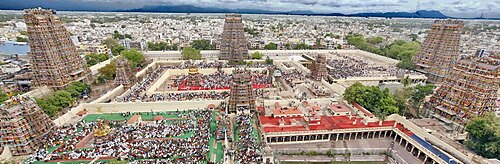
The Meenakshi-Sundareswarar complex sits on the south bank of the Vaigai, over roughly 14 acres. Its 14 gopurams (four 9-storey, one 7-storey, five 5-storey, two 3-storey, and two gold-clad vimanas) form the silhouette most associated with Tamil Nadu — the state emblem is, in fact, a stylised western gopuram of this temple. While the Pandya kings of the 12th–14th centuries established the present configuration, most of the visible superstructure was rebuilt by the Madurai Nayaks (Vishvanatha and Tirumala Nayak) following the destruction wrought by Malik Kafur's raid of 1310–1311.
The temple is administered by the Tamil Nadu Hindu Religious and Charitable Endowments Department (HR&CE) and is one of India's most visited religious sites, drawing in excess of 25,000 pilgrims on ordinary days and over a million during Chithirai. It received the Government of India's "Swachh Iconic Place" designation in 2017.
Ritual life
Meenakshi's daily cycle is governed by the six-kala puja system detailed by Fuller (1984). The distinctive feature, unusual for a South Indian temple, is the nightly palli-arai procession: a silver utsava-murti of Sundareswarar is carried to Meenakshi's shrine to sleep beside her, enacting their marriage every night. This ritual is the liturgical armature of the grihastha-pati theology in which Meenakshi is simultaneously queen of Madurai, warrior-goddess, and devoted householder wife.
Why this entry matters
Meenakshi is the Tamil Nadu anchor in the ELGODS T0 census because she is the most textually, ethnographically, and archaeologically documented Tamil goddess; because her temple is the single most legible site of South Indian Shakta royal cult; and because her mythology integrates cleanly with the surrounding entries on Sundareswarar, Kallazhagar, Ayyanar, and the Chithirai festival — making Madurai a coherent pilot cluster.
Wisdom Graph: Divine Associations
- Vāhana
- SiṁhaVyāghra (Tiger)
- Sacred animals
- parrot (kāñcana-śuka — green parrot on her hand)tiger (puli — South Indian tradition; Sanskrit 'siṃha' rendered as tiger)
- Sacred birds
- parrot
- Sacred flowers
- lotusmallikā (jasmine)red hibiscus
- Sacred plants
- kadamba tree
- Sacred trees
- kadamba (sthala-vṛkṣa of Madurai)
- Offerings
- silk sareegold ornamentskumkumkadamba garland
- Weapons / emblems
- sugarcane bow (śāradā-cāpa)parrot
- Sacred colours
- green (Mīnākṣī's complexion)gold
Primary Scriptural Sources
- Tiruvilaiyāṭaṟpurāṇampurana16th c. CEParañcōti Muṉivar
- Hālāsya Māhātmyapurana
- Mīnākṣī Pañcaratnamstotra9th c. CEĀdi Śaṅkarācārya
Sources & provenance
- 📜Primary sourceBookC. J. Fuller. Servants of the Goddess: The Priests of a South Indian Temple (1984) pp. 1–34, 120–161Foundational ethnography of the Meenakshi temple priesthood
- 📜Primary sourceBookWilliam P. Harman. The Sacred Marriage of a Hindu Goddess (1989) pp. 1–178Indiana University Press; comprehensive study of Meenakshi mythology and the Chithirai Tirukalyanam
- 📜Primary sourceArticleHolly Baker Reynolds. The Auspicious Married Woman (1980) pp. 35–60In Wadley, ed., The Powers of Tamil Women
- 📜Primary sourceBookSusan Bayly. Saints, Goddesses and Kings: Muslims and Christians in South Indian Society, 1700–1900 (1989) pp. 27–69Cambridge University Press
- 📜
- 📜Primary sourceTemple TrustArulmigu Meenakshi Sundareswarar Thirukoil — official siteUnder Tamil Nadu HR&CE DepartmentView source →